Molting (Feather Loss) in Chickens: Symptoms, Causes and Treatment
Molting in chickens is the normal replacement of old feathers with new plumage, usually triggered by shorter daylight in late summer or fall. Birds lose feathers in a recognizable pattern, stop or reduce laying, and need extra dietary protein while feathers regrow. It requires supportive nutrition and low stress, not medical treatment, unless feather loss is caused by parasites or disease.
Veterinarian Reviewed
FlockVet Veterinary Editorial Team· Reviewed August 2026
At a Glance
- Urgency
- Mild
- Contagious
- No
- Affects Humans
- No
- Key Symptoms
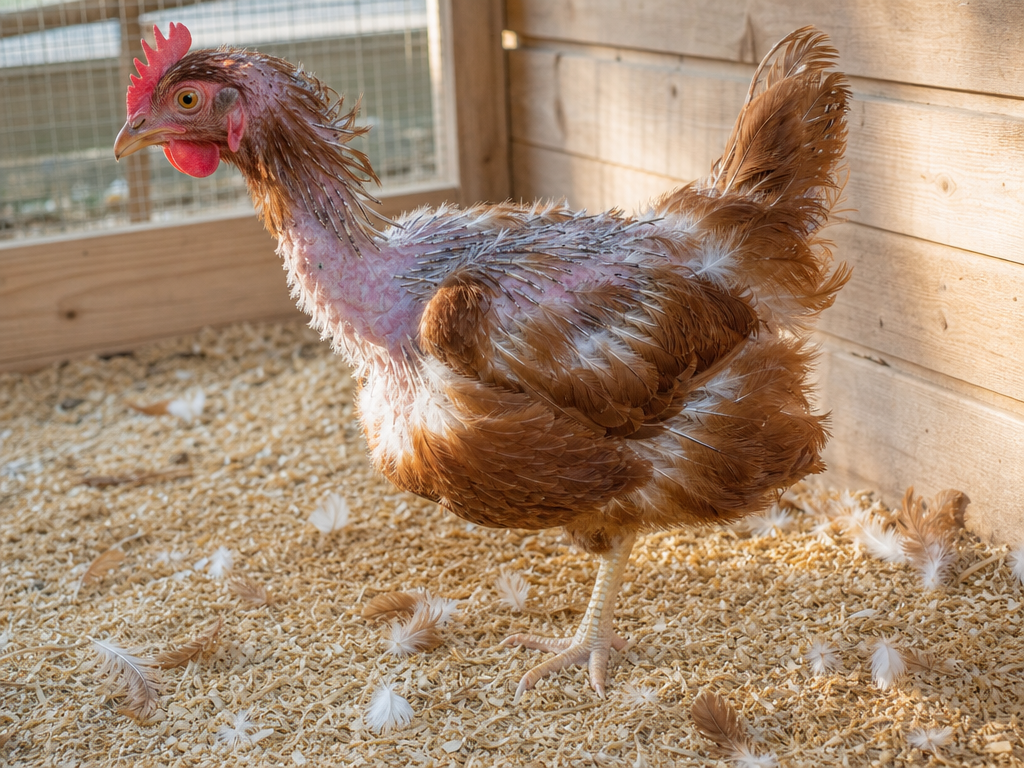
- feather loss beginning at the head and neck, progressing down the body toward the tail, pin feathers - narrow, waxy-sheathed new feathers pushing through bare skin, bare skin patches on the neck, back, breast, and around the tail base
- Prognosis
- Molting is a normal process. Full feather regrowth takes 8-16 weeks. Egg production resumes 4-8 weeks after molt completion in most hens.
📑 On This Pagetap to expand
🔍What Are the Symptoms of Molting (Feather Loss)?
- ●Feather loss beginning at the head and neck, progressing down the body toward the tail
- ●Pin feathers - narrow, waxy-sheathed new feathers pushing through bare skin
- ●Bare skin patches on the neck, back, breast, and around the tail base
- ●Reduced or completely stopped egg production
- ●Increased appetite, especially interest in protein-rich foods
- ●Irritability, reduced social activity, and preference for solitude
- ●Skin sensitivity - reluctance to be picked up or touched during active pin feather growth
- ●Dull, rough appearance of remaining feathers before they drop
🧬What Causes Molting (Feather Loss) in Chickens?
Molting is biology, not a problem. Once you understand the trigger, the timing makes perfect sense.
- Photoperiod (natural trigger): Shorter days in late summer signal the pineal gland to drop reproductive hormones. Feather follicles activate and shedding begins - an annual evolutionary reset.
- Age and first molt: Most hens have their first full adult molt at 15-18 months, roughly one year after they start laying. Subsequent molts happen annually, typically August through November.
- Stress-induced (partial molt): Sudden stress - a predator attack, major flock change, or severe illness - can trigger a partial out-of-season molt. This is your flock telling you something went wrong.
- Nutritional deficiency: Severe protein or methionine deficiency can disrupt the normal feather growth cycle. Hens need 18-20% protein during active molt to rebuild plumage efficiently.
- Artificial light disruption: Removing supplemental lighting after winter causes a sudden perceived "short day" that triggers molt. Gradual light reduction is gentler than abrupt changes.
🔬How Is Molting (Feather Loss) Diagnosed?
Molt is usually easy to identify once you know the pattern. The key is confirming that feather loss is following a molt progression - not being driven by parasites, injury, or disease.
How to Confirm Molt
- Head-to-tail sequence: Molt proceeds in a predictable order - head and neck first, then upper back and breast, then body feathers, wings, and finally tail. If feather loss is following this pattern, it is almost certainly molt.
- Pin feathers present: Actively molting hens show pin feathers - waxy, blood-filled quill sheaths pushing up through the skin - alongside bare patches. New growth alongside shedding confirms active molt.
- Fall timing: If it is September through November and your hen is in her second year or beyond, molt is the overwhelming statistical likelihood.
- No insects visible: Part feathers at the vent and under the wings in daylight. Molt does not produce insects or nits. If you see moving insects or white egg clusters on feather shafts, parasites are involved.
- No signs of illness: A molting hen eats well (often more than usual), walks normally, has clear eyes, and is otherwise alert. She is not sick.
Key Differentials - What Else Causes Feather Loss
- Chicken Lice: Chewing lice cause feather loss around the vent, under wings, and at the neck - but you will find the lice themselves. Part the feathers at the vent in daylight and look for tan or gray insects (1-2mm) moving quickly at feather bases, and white nit clusters cemented to feather shafts. Molt produces no insects or nit clusters.
- Poultry Mites: Northern fowl mites form dark crusty masses around the vent and cause severe skin irritation. Red poultry mites hide in the coop during the day and feed at night. Both cause feather damage and loss - but inspecting the bird at the vent or the coop at night will reveal the mites. Molt produces no mites.
- Feather Pecking and Cannibalism: Bare patches from pecking are typically localized, often on the back near the tail, and may show bleeding, broken pin feathers, or raw skin. The pattern is irregular - not the head-to-tail molt sequence. If you observe flock members actively pecking the bare areas of one bird, pecking - not molt - is the cause.
- Marek's Disease: Marek's does not typically cause feather loss. It causes progressive leg or wing paralysis (birds sitting back on their hocks, one wing dropped), grey iris, or tumors. A bird with feather loss AND paralysis needs immediate veterinary evaluation. Molt alone causes no neurological signs.
💊How Is Molting (Feather Loss) Treated?
There is no treatment for molt - because molt is not a disease. What follows is the management protocol that gets your hens through molt faster, with less stress, and back to full production sooner.
Protein Is the Priority
Switch to a high-protein feed for the duration of the molt. Standard layer feed runs 16-17% protein - not enough to fuel feather regrowth at an optimal rate. During molt, target 20-22% crude protein minimum. Options:
- Switch to a game bird or flock raiser feed (typically 20-22% protein) for the flock during molt season. Return to layer feed once pin feathers are fully closed and feather cover is restored.
- Keep hens on layer feed and supplement with high-protein foods daily (see Natural Care section) to bring the effective protein intake up.
- If using layer feed only, supplement with a poultry amino acid supplement - particularly methionine and cysteine, the sulfur-containing amino acids that form the backbone of keratin - per the manufacturer's dosing guidance.
Do not cut protein to save money during molt. Inadequate protein during active feather regrowth slows the molt, extends the egg-free period, and produces lower-quality feathers that break more easily.
Minimize Handling During Pin Feather Growth
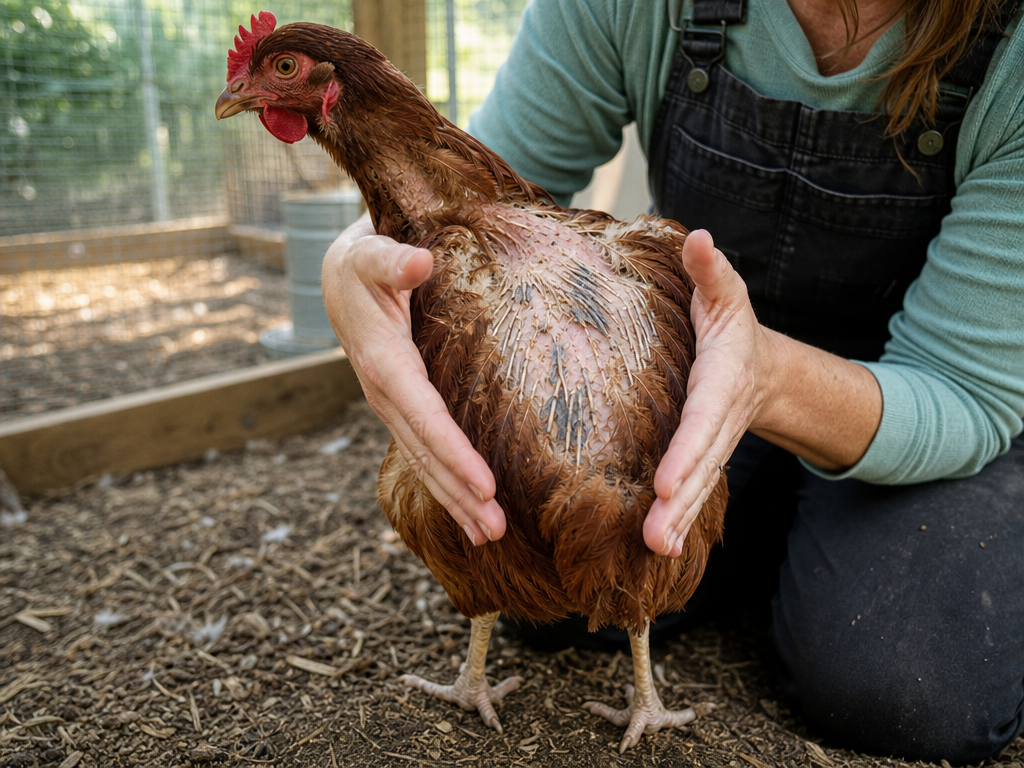
Pin feathers (also called blood feathers) have an active blood supply. They are painful when touched or broken. During the 3-6 weeks of peak pin feather growth, minimize handling your birds. Do not hug or carry hens unnecessarily. If a pin feather breaks and bleeds, apply light pressure to stop the bleeding. A repeatedly broken pin feather in an unreachable location may need to be fully removed by grasping it close to the follicle and pulling firmly - this is uncomfortable for the bird but stops ongoing bleeding.
Lighting Management
Artificial coop lighting (to extend day length and maintain egg production year-round) suppresses the natural molt signal. If your flock is on supplemental lighting and they begin to molt anyway, you can choose to reduce or remove the artificial light for 6-8 weeks to allow the molt to complete faster, then restore lighting to restart production. Alternatively, maintain lighting to try to push through a soft molt - but understand this may prolong a partial molt and delay a clean production restart.
Do not add supplemental light in an attempt to stop an active molt already in progress. Once the molt cycle is triggered, it will complete regardless of photoperiod intervention.
Reduce Flock Stress
Stress slows molt completion and suppresses immune function. During molt:
- Avoid introducing new birds to the flock until molt is complete
- Do not coop-move, transport, or significantly change flock management
- Ensure adequate feeder and waterer space so molting hens - who may be irritable - can eat without competition pressure
- Maintain clean, dry bedding to prevent secondary skin irritation on bare patches
Is My Chicken Molting or Do They Have Mites?
Normal molt usually begins around the head and neck and progresses through the body, with clean skin and new pin feathers appearing in an orderly pattern. Mites more often cause irregular loss, irritation, vent debris, anemia, or nighttime restlessness. Part feathers around the vent and inspect roost cracks after dark before assuming seasonal feather loss is normal.
Natural & Integrative Care for Molting (Feather Loss)
Molt is biology, not illness - the right protein protocol (20%+ feed, mealworms, sunflower seeds, and eggs daily) shortens the molt timeline and restores egg production faster than any other intervention.
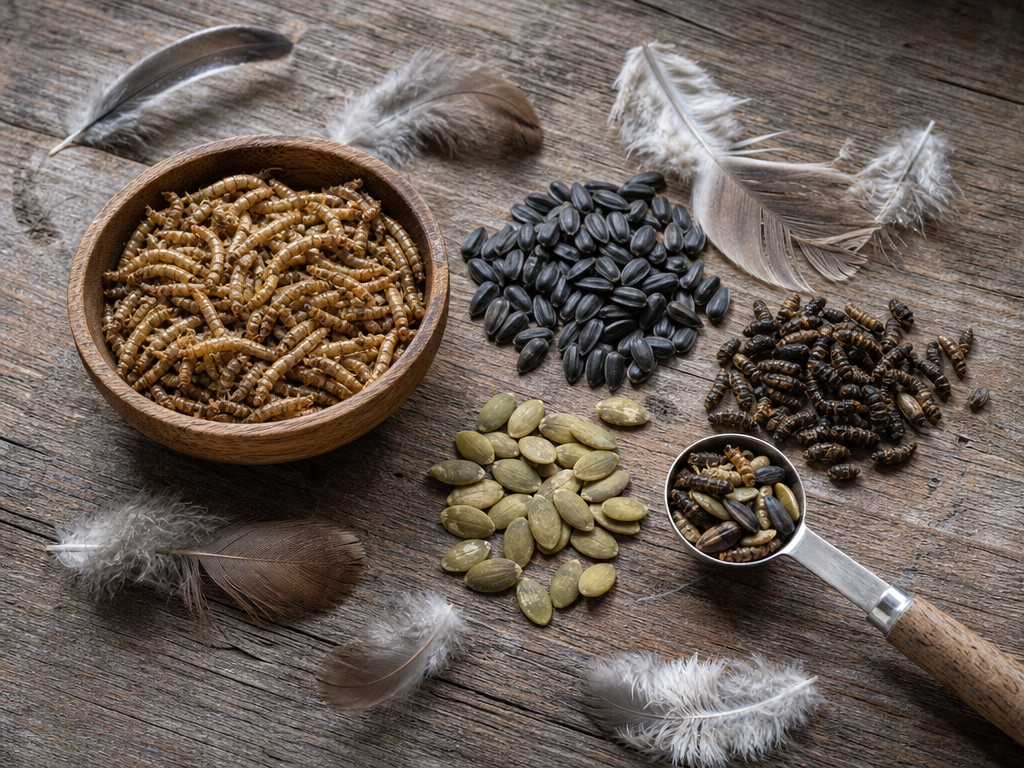
The single highest-impact thing you can do during molt is feed more protein from whole food sources. Below are the most effective options with specific amounts. These supplement (or partially replace) the daily ration - they are not treats to be given in tiny quantities.
Dried Mealworms
Protein content: ~50-55% crude protein (dried)
Feed 1-2 tablespoons per bird per day during active molt. Scatter in the run or mix into feed. Do not exceed 2 tablespoons per bird - mealworms are high in fat and phosphorus, which can unbalance calcium levels if fed in excess. Mealworms are the most protein-dense supplement most keepers can source easily, and chickens eat them enthusiastically.
Black Soldier Fly Larvae (BSFL)
Protein content: ~42% crude protein (dried); higher in fresh
Feed 1 tablespoon dried BSFL per bird per day, or a small handful of fresh larvae. BSFL also contains lauric acid, which has documented antimicrobial properties, and has a better calcium-to-phosphorus ratio than mealworms. It is increasingly available at feed stores and online.
Scrambled or Hard-Boiled Eggs
Protein content: ~13% in whole egg
Feed 1 whole egg scrambled for every 4 birds, 2-3 times per week. Eggs are a complete protein source containing all essential amino acids including methionine and cysteine - the two sulfur-containing amino acids that form the backbone of keratin (feather protein). This is one of the most bioavailable protein sources you can provide, and it is free if you have laying hens.
Black Oil Sunflower Seeds (BOSS)
Protein content: ~16-17%; also high in vitamin E and linoleic acid
Feed 1-2 tablespoons per bird per day. Sunflower seeds provide protein, healthy fats for skin conditioning, and vitamin E - a key antioxidant that supports feather follicle health. The shells are fine for chickens to eat; whole seeds can be fed directly or mixed into feed.
Fermented Feed
Replace 25-50% of the daily ration with fermented layer or flock raiser feed during molt. Fermentation increases protein bioavailability by breaking down anti-nutritional factors, and adds probiotic bacteria that support gut health under the metabolic stress of active feather regrowth. Use a simple lacto-ferment: cover feed in water, weight it down, ferment at room temperature for 3-4 days until pleasantly sour-smelling. Feed the soft, wet fermented feed fresh daily.
Pumpkin Seeds
Protein content: ~30% crude protein
Feed a small handful (about 1 tablespoon) per bird 2-3 times per week. Raw pumpkin seeds are high in zinc, which supports skin integrity and feather follicle function. They are particularly useful in the early pin feather stage when follicle health matters most.
🛡️How Can Molting (Feather Loss) Be Prevented?
You cannot prevent molting - and you should not want to. The annual molt renews your hen's feather coat, resets her reproductive cycle, and is essential for long-term laying performance. What you can do is manage the conditions that affect how smoothly the molt progresses.
- Year-round nutrition: Hens that enter molt well-nourished (adequate protein, calcium, vitamins A and E year-round) complete feather regrowth faster. Maintain at least 16-18% protein in the daily diet even outside of molt season. Hens going into molt depleted from a long, nutritionally inadequate laying cycle take longer to complete regrowth.
- Flock stability in fall: Avoid introducing new birds in September-November. New bird introductions trigger flock-wide stress and social restructuring - which compounds the physiological stress of active molt and can slow completion.
- Consistent lighting decisions: If you use supplemental coop lighting year-round to maintain production, do so consistently. Erratic light schedules - lights on for months, then suddenly off - can trigger abrupt partial molts at unpredictable times. Consistency in photoperiod, whether you are extending day length or not, makes molt more predictable.
- Do not suppress molt indefinitely: Hens on continuous supplemental lighting that suppresses molt for multiple years lay lower-quality eggs, experience higher rates of reproductive disease, and produce poorer feather cover over time. A clean annual molt is better for long-term flock health than indefinitely delayed molting.
📞When Should I Call a Vet for Molting (Feather Loss)?
Most molting chickens do not need a veterinarian. Contact your vet if you observe any of the following - these indicate that something beyond normal molt may be happening:
- Bleeding pin feathers across multiple sites: One broken pin feather is common and manageable at home. Multiple bleeding sites, or pin feathers that bleed repeatedly despite protection, may indicate a clotting issue or flock pecking problem that needs assessment.
- Extensive raw skin damage: Small bare patches during molt are normal. Skin that is bleeding, deeply irritated, infected-looking (hot, swollen, oozing), or being actively pecked by flockmates requires intervention beyond normal molt management.
- Significant weight loss: A hen in active molt may lose some condition as protein is redirected, but should not lose more than 10-15% of body weight. A visibly emaciated hen - sharp keel bone, sunken muscle mass - is not just molting normally.
- Molt lasting longer than 16 weeks without completion: A full molt cycle should complete within 8-16 weeks. A hen still in active molt at week 17 or beyond, or whose pin feathers are not closing and hardening, may have an underlying nutritional deficiency, parasite burden, or health issue interfering with regrowth.
- Neurological signs alongside feather loss: Limping, leg weakness, sitting on haunches, dropped wing, or grey iris alongside feather loss is not molt - it may be Marek's Disease or another systemic condition requiring diagnosis.
❓Molting (Feather Loss): Frequently Asked Questions
When do chickens molt?
Most chickens molt once a year, typically in late summer or fall when daylight hours begin to shorten, usually between August and November. The decreasing light triggers hormonal changes that initiate molt. Some hens molt in spring if they began laying in fall the previous year.
How long do chickens molt?
A natural, gradual molt typically lasts 4-6 months in backyard flocks. Hard molt (fast, aggressive feather loss) takes 2-3 months but causes more stress. Commercial forced molts using fasting protocols can be completed in 4-8 weeks. During this time, egg production stops almost entirely.
How often do chickens molt?
Chickens molt once per year as adults, typically in the fall. Young chicks go through several partial molts in their first year as they grow from down into juvenile feathers and then adult plumage. After a hen's first adult molt (usually at 15-18 months), annual molting continues throughout her life.
Is my chicken molting or do they have mites?
Molting feather loss starts from the head and neck and progresses down the body in a predictable pattern. The skin underneath is healthy and clean. Mite infestation causes patchy, irregular feather loss, often around the vent, and the skin may appear irritated or scaly. Check feather shafts - mite eggs appear as white debris at the base.
What is molting in chickens?
Molting is the natural annual process where chickens shed and replace their feathers. During molt, egg production slows or stops as the body redirects protein and nutrients toward feather regrowth rather than egg production. It is a normal, healthy process - not a sign of illness.
Why do chickens molt?
Chickens molt to replace worn, damaged feathers with fresh plumage before winter. Feathers are critical for insulation and waterproofing. Shorter fall daylight hours trigger hormonal changes that initiate the process. Stress, poor nutrition, and disease can also trigger an out-of-season partial molt.
📋Key Points
- ✓Molting is biology, not a problem.
- ✓Key symptoms: feather loss beginning at the head and neck, progressing down the body toward the tail, pin feathers - narrow, waxy-sheathed new feathers pushing through bare skin, bare skin patches on the neck, back, breast, and around the tail base, reduced or completely stopped egg production.
- ✓Molting is a normal process. Full feather regrowth takes 8-16 weeks. Egg production resumes 4-8 weeks after molt completion in most hens.
🔗Related
Related Conditions
Natural Remedies & Supplements
📚Sources & References
- 1.Molt in Poultry. Merck Veterinary Manual. 2024
- 2.Poultry Nutrition During Molt. University of Georgia Cooperative Extension Poultry Science. 2023
- 3.Management of Backyard Poultry. Merck Veterinary Manual. 2024