Bumblefoot (Plantar Pododermatitis) in Chickens: Symptoms, Causes and Treatment
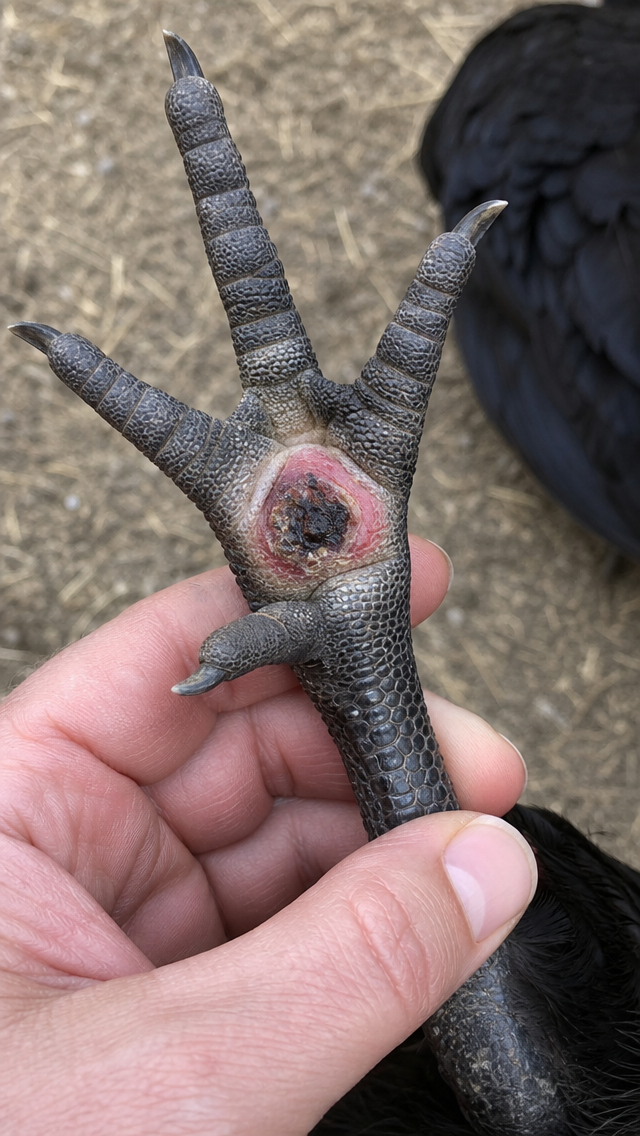
Bumblefoot in chickens is bacterial pododermatitis, usually caused when Staphylococcus aureus enters a cut or pressure injury in the footpad. Typical signs are footpad redness, swelling, limping, and a dark central scab. Mild cases need cleaning, topical antiseptic, and bandaging, while deep abscesses require veterinary debridement and sometimes systemic antibiotics.
Veterinarian Reviewed
FlockVet Veterinary Editorial Team· Reviewed January 2026
At a Glance
- Urgency
- Moderate
- Contagious
- No
- Affects Humans
- No
- Key Symptoms
- dark scab or callus on the bottom of the footpad, swelling of the foot or toes, limping or favoring one foot
- Prognosis
- Excellent for Grade 1-2 with prompt treatment. Good for Grade 3 with proper surgical debridement. Guarded for Grade 4. Poor for Grade 5.
📑 On This Pagetap to expand
🔍What Are the Symptoms of Bumblefoot (Plantar Pododermatitis)?
- ●Dark scab or callus on the bottom of the footpad
- ●Swelling of the foot or toes
- ●Limping or favoring one foot
- ●Reluctance to walk or stand
- ●Warm, red, or hard footpad
- ●Pus or cheesy material if abscess has formed
- ●Weight loss in severe, chronic cases
🧬What Causes Bumblefoot (Plantar Pododermatitis) in Chickens?
Bumblefoot begins as a wound entry point - a cut, splinter, rough landing surface abrasion, or pressure necrosis from obesity. Staphylococcus aureus is the most common causative organism (present naturally on skin and in the environment), though E. coli, Pasteurella, and other bacteria can also be involved.
Risk factors:
- Hard or rough perches - round, smooth perches of appropriate diameter are significantly protective
- Wire or hardware cloth flooring - the single biggest cause in backyard flocks
- Obesity - excess weight creates pressure necrosis on the footpad
- Wet conditions - chronic moisture softens footpad tissue, making it vulnerable
- Vitamin A or biotin deficiency - weakens skin integrity
- Heavy breeds - Cochins, Brahmas, Orpingtons are highest risk
- Previous foot injuries
🔬How Is Bumblefoot (Plantar Pododermatitis) Diagnosed?
Visual diagnosis by grade is straightforward for experienced keepers:
Bumblefoot Grading Scale:
- Grade 1: Small dark scab, no swelling, bird is not limping. Treat at home.
- Grade 2: Scab with mild swelling, slight limp. Treat at home with close monitoring.
- Grade 3: Significant swelling, distinct abscess, moderate to severe limp. Vet consultation advised.
- Grade 4: Severe swelling, deep infection, possible bone involvement, bird barely walking. Veterinary surgery required.
- Grade 5: Systemic infection, multiple joints involved, life-threatening. Emergency vet care.
When in doubt, press gently on the swelling. If you feel a firm, waxy core, it is an abscess (Grade 3+). If the foot is uniformly soft and swollen with no discrete core, it may be a Grade 2 inflammatory response.
💊How Is Bumblefoot (Plantar Pododermatitis) Treated?
Grade 1-2 (home treatment appropriate):
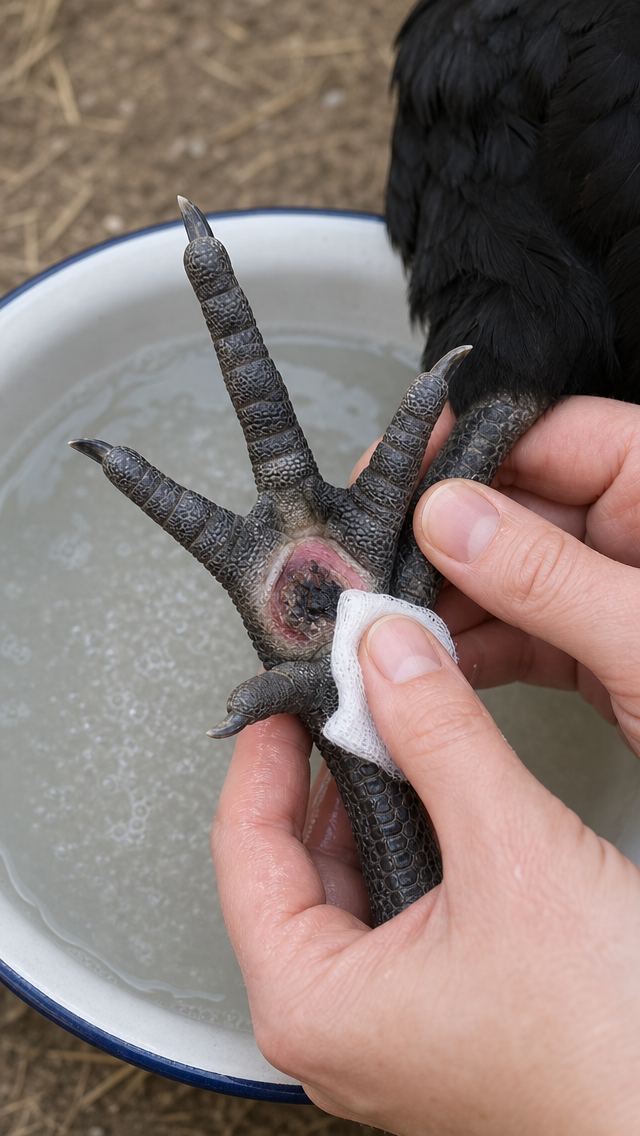
- Soak foot in warm Epsom salt water for 15-20 minutes to soften the scab
- Gently remove the scab - if it doesn't come off easily, do not force it
- Express any pus gently (Grade 2)
- Flush with dilute Betadine or chlorhexidine solution
- Apply antibiotic ointment (Neosporin without pain relief)
- Bandage with a clean gauze pad and vet wrap
- Change dressing every 2-3 days
- Keep bird on clean, soft bedding during healing
Grade 3 (vet guidance recommended):
- Surgical debridement under local anesthesia to remove the caseous abscess core
- Amoxicillin or enrofloxacin systemically for 7-14 days
- Topical antibiotic and bandaging
Grade 4-5 (emergency vet care):
- Surgical debridement, possible bone curettage
- IV antibiotics
- Prognosis guarded at Grade 4, poor at Grade 5
Antibiotics for bumblefoot in chickens
Topical antibiotic ointment without pain reliever is appropriate after cleaning mild surface lesions. Oral amoxicillin may be prescribed for Grade 3 or deeper infection, with the dose calculated by a veterinarian from the bird's weight, culture results, and product concentration. Deep swelling, a hard abscess core, lameness, spreading redness, or suspected bone involvement needs veterinary debridement and systemic treatment. Follow the veterinarian's egg withdrawal instructions.
Natural & Integrative Care for Bumblefoot (Plantar Pododermatitis)
Grade 1-2 bumblefoot resolves consistently with Epsom salt soaks and manuka honey bandaging. Grade 3+ requires conventional debridement, but natural care supports healing before and after.
Grade 1 and Grade 2 bumblefoot respond exceptionally well to natural care. This is one of the clearest wins for integrative treatment in poultry.
Manuka Honey Protocol (Grade 1-2)
Manuka honey (UMF 10+ or higher) has well-documented antimicrobial, anti-inflammatory, and wound-healing properties. After softening and cleaning the foot:
- Apply a generous layer of raw manuka honey directly to the wound and scab area
- Cover with a clean gauze pad
- Wrap with vet wrap (not too tight - check circulation)
- Change every 48 hours
- Most Grade 1 cases heal completely within 2-3 weeks with this protocol
Epsom Salt Soaks
1 tablespoon Epsom salt per quart of warm water. Soak for 15-20 minutes daily. Draws infection, reduces inflammation, and softens tissue for better healing. One of the most effective and inexpensive interventions available.
Turmeric Paste (anti-inflammatory)
Mix turmeric powder with coconut oil to form a paste. Apply to the wound area after cleaning. Curcumin (turmeric's active compound) has demonstrated anti-inflammatory and antimicrobial effects in wound healing research. Not a replacement for wound care - use alongside honey or antibiotic ointment.
Calendula salve
Applied topically, calendula accelerates tissue repair and has mild antimicrobial properties. Useful in the healing phase (after infection is controlled) to support new tissue formation.
Environmental correction (prevents recurrence):
- Replace wire flooring with solid, smooth surfaces
- Install round perches of correct diameter (1-2 inches for standard breeds)
- Deep dry bedding (sand or shavings) to cushion footpads
- Rubber stall mats in high-traffic areas

🛡️How Can Bumblefoot (Plantar Pododermatitis) Be Prevented?
- Inspect footpads weekly - Grade 1 caught early takes 2 weeks to resolve; Grade 3 caught late may require surgery
- Eliminate all wire flooring - hardware cloth is the leading environmental cause
- Proper perch sizing and material - round, smooth wood of appropriate diameter
- Keep coop dry - wet bedding is a major risk factor
- Maintain healthy body weight - reduce scratch grains for obese birds
- Vitamin A and biotin in diet - squash, sweet potato, leafy greens
📞When Should I Call a Vet for Bumblefoot (Plantar Pododermatitis)?
Call a vet if:
- Swelling is large (larger than a pea) or the foot feels rock-hard
- Bird is not bearing weight at all
- Foot is hot to the touch and visibly infected
- No improvement after 2 weeks of home treatment
- Bird appears lethargic or has stopped eating (suggests systemic spread)
- Infection appears to involve the joint or bone
❓Bumblefoot (Plantar Pododermatitis): Frequently Asked Questions
How do you treat bumblefoot in chickens?
Mild bumblefoot (Grade 1-2) can be treated at home by soaking the foot in warm Epsom salt water for 10-15 minutes, applying an antiseptic, and wrapping with clean bandages. Change dressings daily. Grade 3 or higher with a hard black scab requires surgical removal of the core - consult a vet.
What causes bumblefoot in chickens?
Bumblefoot is caused by a bacterial infection, usually Staphylococcus aureus, that enters through a small cut or abrasion on the foot. Hard or rough roosts, wire flooring, obesity, and jumping from high perches are the most common causes. Wet, dirty bedding makes existing wounds worse.
Can chickens get bumblefoot from antibiotics?
Antibiotics treat the bacterial infection behind bumblefoot, not cause it. Oral antibiotics such as amoxicillin or trimethoprim-sulfamethoxazole are prescribed for moderate to severe cases. Topical antibiotic ointment is used on all grades after cleaning. A vet should confirm the severity before prescribing.
How do chickens get bumblefoot?
Chickens get bumblefoot when bacteria enter through a small cut or puncture on the foot pad. Common entry points include scrapes from rough roosts, wire floors, or landing hard from height. Once bacteria are inside, they form an abscess beneath the skin.
What does bumblefoot look like in chickens?
Bumblefoot appears as swelling on the bottom of the foot, often with a dark brown or black scab at the center. Grade 1 shows only redness. Grade 2 has a defined scab. Grade 3 has a hard, embedded core with significant swelling. The affected foot may feel warm to the touch.
📋Key Points
- ✓Bumblefoot begins as a wound entry point - a cut, splinter, rough landing surface abrasion, or pressure necrosis from obesity.
- ✓Key symptoms: dark scab or callus on the bottom of the footpad, swelling of the foot or toes, limping or favoring one foot, reluctance to walk or stand.
- ✓Excellent for Grade 1-2 with prompt treatment. Good for Grade 3 with proper surgical debridement. Guarded for Grade 4. Poor for Grade 5.
🔗Related
Related Conditions
Medications
Natural Remedies & Supplements
📚Sources & References
- 1.Bumblefoot (Pododermatitis) in Poultry. Merck Veterinary Manual. 2024
- 2.Common Management-Related Problems in Backyard Poultry. Merck Veterinary Manual. 2024
- 3.Management of Backyard Poultry. Merck Veterinary Manual. 2024
- 4.Poultry Programs - UC Davis School of Veterinary Medicine. UC Davis Veterinary Medicine Extension. 2024