Poultry Red Mite in Chickens: Symptoms, Causes and Treatment
Red mites in chickens are nocturnal blood-feeding parasites that hide in coop cracks and roost fittings during daylight. Infestations cause nighttime restlessness, anemia, pale combs, reduced production, and dark or red smears on nighttime inspections. Elimination requires simultaneous treatment of birds and the entire coop, repeated to break the mite life cycle.
Veterinarian Reviewed
FlockVet Veterinary Editorial Team· Reviewed August 2026
At a Glance
- Urgency
- Moderate
- Contagious
- Yes
- Affects Humans
- Yes, zoonotic
- Key Symptoms
- restlessness and agitation at night when birds go to roost - birds pace, refuse to settle, or leave the coop, pale or white comb and wattles - the clearest sign of blood-loss anemia from repeated nightly feeding, egg production drops 20–30% with no other obvious cause
- Prognosis
- With simultaneous coop and bird treatment followed by a repeat dose at 7 days, 95% of flocks clear active infestation within 2–3 weeks. Anemic birds typically regain normal comb color and return to full egg production within 2–4 weeks after parasite elimination, provided they have access to iron-rich greens (spinach, nettles) and adequate protein in feed.
📑 On This Pagetap to expand
🔍What Are the Symptoms of Poultry Red Mite?
- ●Restlessness and agitation at night when birds go to roost - birds pace, refuse to settle, or leave the coop
- ●Pale or white comb and wattles - the clearest sign of blood-loss anemia from repeated nightly feeding
- ●Egg production drops 20–30% with no other obvious cause
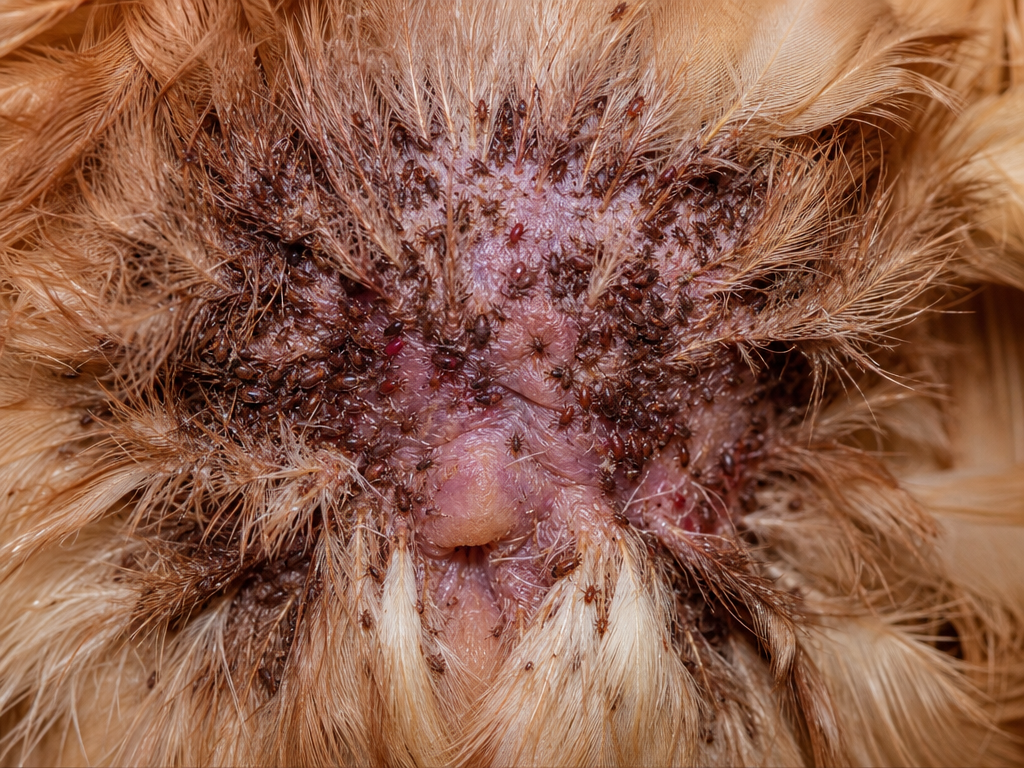
- ●Tiny red, brown, or gray moving specks in coop cracks, roost seams, and under perch brackets - visible only at night or with a flashlight
- ●Grayish dust-like residue under roosts (mite feces and shed skins) - a daytime red flag for heavy infestation
- ●Weight loss and reduced feed conversion despite consistent feeding
- ●Irritability and increased feather pecking from skin irritation at feeding sites
- ●Hesitation or refusal to enter the coop at dusk - birds associate the coop with biting
- ●Weakness, lethargy, or collapse in severely anemic birds
- ●Death in chicks under 6 weeks or heavily parasitized adults from blood loss
🧬What Causes Poultry Red Mite in Chickens?
Dermanyssus gallinae - the red poultry mite, also called the chicken mite or roost mite - is a coop parasite, not a bird parasite. This distinction defines everything about how you find it and eradicate it.
The Life Cycle: 7 Days at 20°C
At 20°C (68°F), red mites complete the full egg → larva → protonymph → deutonymph → adult cycle in 7 days. At warmer summer temperatures (30°C / 86°F), this compresses to 5 days. A single female lays up to 30 eggs per blood meal. These numbers explain how a handful of hitchhiking mites can become a 200,000-mite infestation within 3 months - exponential reproduction inside a warm, sheltered coop is essentially unchecked without active management.
Night Feeding Behavior
Mites emerge from hiding after dark, travel up to several meters to reach sleeping birds, feed for 20–90 minutes, and return to crevices before dawn. This means that during daylight hours - when most keepers check their flock - the birds can appear completely healthy and parasite-free while thousands of mites wait in the structure around them. The red color of a recently fed mite comes from the blood it has consumed; unfed mites are gray or white and much harder to see.
Where Mites Harbor in the Coop
- Roost seams and under-perch brackets (highest density)
- Cracks in wooden perches - especially rough, untreated timber
- Nest box corners and the junction between nest boxes and walls
- Coop wall joints, gaps between boards, and under removable nest box floors
- Behind feeders or drinkers fixed to walls
Metal or plastic perches have dramatically fewer harbor sites than wood. A coop with smooth surfaces, sealed joints, and no clutter is structurally resistant to red mite accumulation.
How Infestations Enter a Clean Flock
- New birds: Mites can arrive on purchased birds - even if those birds show no daytime signs
- Wild birds: Sparrows, starlings, and pigeons roosting near or in the coop are a primary source; wild birds carry high mite loads
- Contaminated equipment: Used nest boxes, transport crates, second-hand coop materials
- Human contact: Clothing and shoes from visiting an infested flock
Why Red Mites Differ from Northern Fowl Mites
The poultry mites overview covers both species. The critical operational difference: northern fowl mites (Ornithonyssus sylviarum) live permanently on the bird and are visible during daytime feather inspection. Red mites live in the coop and are almost never on birds during the day. Treating birds only - without coop treatment - eliminates the northern fowl mite but has zero lasting effect on the red mite population.
🔬How Is Poultry Red Mite Diagnosed?
Red mites are almost never found during daytime flock checks - diagnose them in the coop, not on the birds.
The White Paper Test (Most Reliable Home Test)
Lay a sheet of white paper or a white cloth under the main roost before dark. Check it 1–2 hours after the birds have settled. Moving red, orange, or gray specks on the paper are red mites. In heavy infestations, you will see dozens within seconds. In lighter infestations, use a magnifying glass - mites are 0.5–1mm long.
Flashlight Night Inspection
After the birds have been roosting for at least an hour, shine a bright flashlight directly into roost seams, the junction between perch and bracket, nest box corners, and any cracks in the coop walls near the roost. Tap the roost surface - mites will scatter from the vibration. In heavy infestations you will see waves of tiny specks moving in all directions. Check the birds themselves: look at the vent feathers and breast for tiny specks crawling on bare skin.
Daytime Signs of Heavy Infestation
Grayish-brown dust under roosts - mite feces, shed skins, and egg casings - accumulates in heavy infestations and is visible during daylight. Scrape a credit card through deep coop cracks and examine the residue on white paper. In very heavy infestations, mites may be found in daylight in sheltered crevices.
Differentials - Conditions That Look Similar
- Northern fowl mite (Ornithonyssus sylviarum): If you find mites on the bird during daytime feather inspection - especially dark, crusty masses around the vent - it is northern fowl mite, not red mite. Both cause anemia, but the treatment approach differs because northern fowl mites must be eliminated from the bird, not just the coop. See the poultry mites article for the full comparison.
- Chicken lice: Larger (1–2mm), tan or gray, found on the bird during daytime inspection, leave white nit clusters cemented to feather shafts near the vent and neck. Lice are chewing parasites - they do not cause significant anemia.
- Anemia from other causes: Pale comb with no mites found on nighttime inspection should prompt investigation for coccidiosis, internal laying, or nutritional deficiency. See the anemia guide for the differential workup.
- Normal behavior variation: Some restlessness at roost is normal. The combination of pale comb + reduced egg production + nighttime agitation is the red mite triad - one sign alone is not diagnostic.
💊How Is Poultry Red Mite Treated?
The rule that determines whether treatment works or fails: treat the coop and birds simultaneously. Treating birds alone will fail within 72 hours, as the coop population - untouched - reinfests treated birds the following night.
Step-by-Step Eradication Protocol
- Remove all birds from the coop. Set them in a temporary pen or enclosed run.
- Remove all bedding. Bag and dispose of it; do not compost. Mites and eggs are in the litter.
- Treat the coop structure:
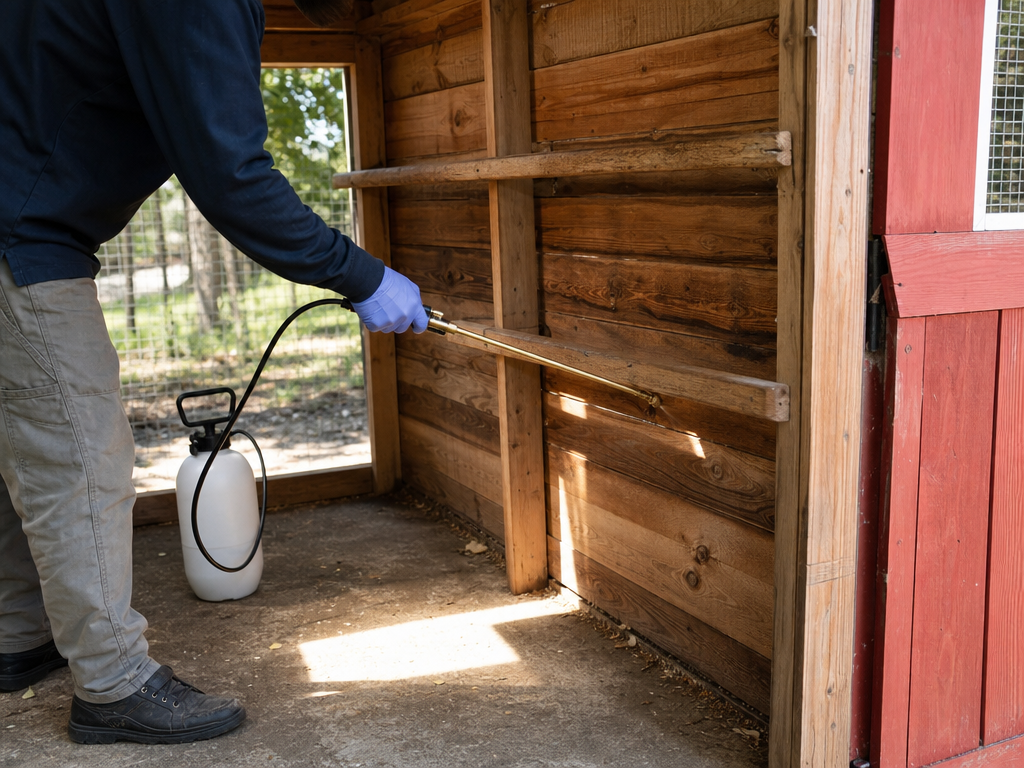
- Permethrin 0.5% spray (diluted from 10% concentrate per label) - spray all cracks, roost seams, under brackets, nest box corners, and wall joints. Use a pressurized sprayer to push product into crevices. Permethrin is a pyrethroid with rapid knockdown. Note: some European populations show developing resistance; if treatment fails after two rounds, switch to spinosad.
- Spinosad (Elector PSP, undiluted) - spray directly into crevices and on all coop surfaces. Spinosad has a different mode of action and is effective against permethrin-resistant populations. It also has a lower mammalian toxicity profile.
- Allow the coop to dry fully (minimum 2 hours) before returning birds.
- Treat the birds:
- Permethrin dust (0.25%) - apply to vent area, under wings, neck, and fluff feathers. This is a contact product for any mites found on birds.
- Spinosad (Elector PSP) spray on birds - lower toxicity than permethrin and effective on birds with confirmed mite burden.
- Ivermectin pour-on (0.1ml per 500g body weight, applied to bare neck skin) - use for heavy infestations with visible anemia. Egg withdrawal: 14 days per current FARAD guidance. Confirm with your state's prescribing guidance before use.
- Ivermectin oral (0.2mg/kg mixed into feed) - alternative to pour-on; same withdrawal period applies.
- Dust coop cracks and under roosts with food-grade diatomaceous earth as a residual mechanical barrier after the spray dries.
- Repeat the full protocol in 7 days. This kills mites that hatched from eggs after the first treatment. A second repeat at 21 days is recommended for heavy infestations to catch any survivors.
Withdrawal times for laying hens: Permethrin dust is generally considered safe for laying hens with minimal egg withdrawal at label rates; confirm the specific product label. Ivermectin requires a 14-day egg withdrawal based on current FARAD guidance - do not use eggs from treated birds during this period.
Do not use: Organophosphates (malathion) in coops with birds present - high toxicity risk. Avoid applying any spray directly to the face, eyes, or beak of birds.
Natural & Integrative Care for Poultry Red Mite
Knock down an established red mite infestation with permethrin or spinosad applied to both coop and birds simultaneously, then use garlic water, DE dust baths, and weekly neem oil sprays to prevent population rebuild - these natural tools have real evidence for suppression but cannot eradicate a heavy infestation fast enough to protect anemic birds.
Natural treatments are highly effective for mild-to-moderate infestations and as ongoing prevention after a conventional knockdown. They are not fast enough as sole treatment when birds are pale, weak, or showing signs of anemia - use conventional treatment to knock the population down first, then natural protocols to maintain control.
Food-Grade Diatomaceous Earth (DE)
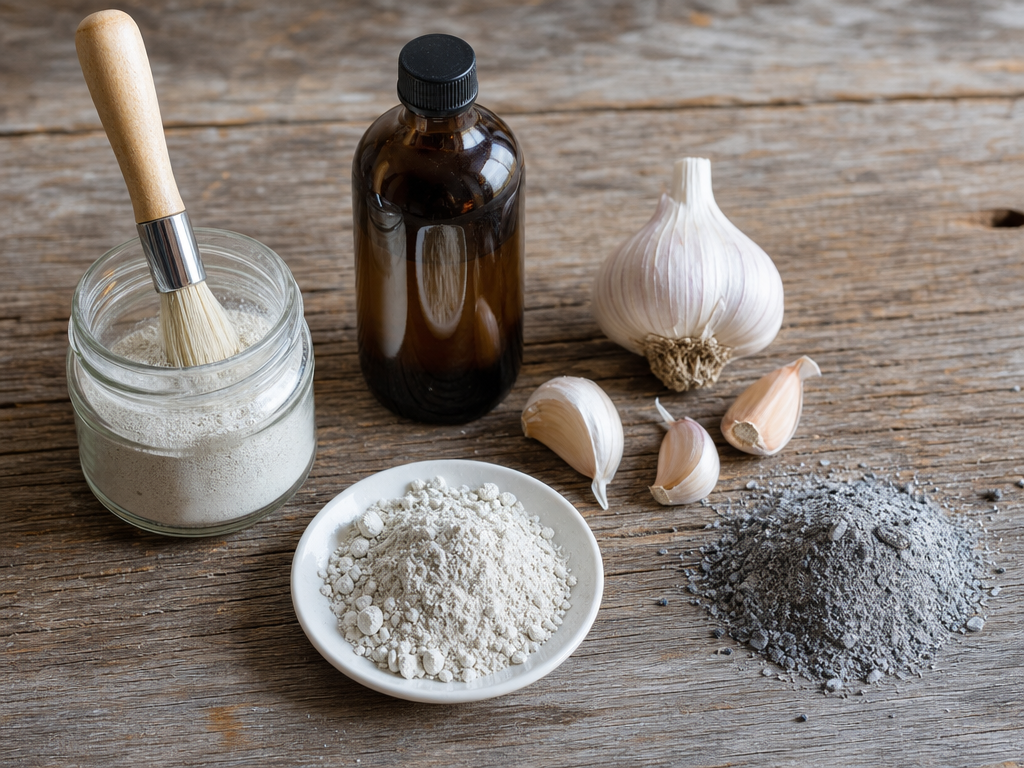
DE is a mechanical insecticide - fossilized diatom shells that damage the mite's waxy exoskeleton, causing death by desiccation. Use food-grade DE only (never pool-filter DE, which is chemically treated). Apply liberally to all coop cracks, under roosts, and in nest box bedding. Mix 1 cup per nest box directly into the nesting material. Keep a DE-enriched dust bath available year-round. DE works on contact - it does not penetrate deep into sealed crevices - so heavy mite populations in established harborage sites require a contact spray for full knockdown. Wear a dust mask when applying DE in quantity; inhalation irritates human and bird lungs.
Wood Ash Dust Baths
Wood ash is highly alkaline (pH 9–11) and highly abrasive at the microscopic level. Both properties damage mite exoskeletons and disrupt their waxy cuticle. Chickens given free access to wood ash dust baths show measurably lower ectoparasite loads in observational studies. Offer a dedicated dust bath box (at least 60cm × 60cm × 15cm deep) filled with a 50/50 mix of wood ash and fine dry soil. Refresh monthly. This is free, effective, and birds use it voluntarily.
Neem Oil Spray (2% Solution)
Mix 20ml cold-pressed neem oil per liter of warm water with 3–4 drops of dish soap as an emulsifier. Shake vigorously. Spray roost seams, nest box edges, and coop joints, and directly on birds (vent, under wings, neck). Azadirachtin - the active compound in neem - disrupts mite molting and egg hatching rather than killing adults on contact, so it works best as a suppression and prevention tool. Reapply weekly. Neem degrades rapidly in sunlight; spray late afternoon or evening for best persistence.
Garlic Water - Systemic Repellent
Crush 4–5 garlic cloves per liter of water. Steep overnight. Use as the sole drinking water source 3 days per week. Allicin and sulfur compounds from garlic are partially excreted through the skin, making blood less palatable to blood-feeding mites. A 2009 study in Poultry Science demonstrated a 16% reduction in red mite numbers in laying hens supplemented with garlic versus controls. Garlic water is a documented adjunct to conventional treatment - not a replacement.
Garlic Spray for the Coop
Steep 10+ crushed cloves per liter overnight; strain and spray directly into roost cracks and crevices. The sulfur-volatile compounds repel mites from treated surfaces for 3–5 days. Reapply twice weekly during active infestations.
Volatile Herb Repellents
Fresh sprigs of lavender, rosemary, mint, or basil placed in nest boxes and hung near roosts release volatile terpenes that mites avoid. Replace every 5–7 days as the volatiles dissipate. Research on terpene insect repellency supports this use, though quantified efficacy data specifically for D. gallinae in commercial settings is limited. These are low-effort, low-cost additions to an integrated protocol.
🛡️How Can Poultry Red Mite Be Prevented?
The highest-impact prevention step is monthly nighttime coop inspection - catching red mites at low numbers costs 5 minutes; eradicating an established infestation costs hours and risks bird health.
- Monthly nighttime white-paper test: Place white paper under roosts 1–2 hours after birds have settled; check for moving specks. Do this every 4 weeks, year-round. Monthly detection at low population levels prevents exponential buildup.
- Replace wooden perches with metal or plastic: Metal roost bars have no crevices or grain for mites to harbor in. Galvanized pipe or PVC perches coated with petroleum jelly at the ends create a nearly mite-proof roost. If wood roosts are kept, sand them smooth, seal with linseed oil or varnish, and inspect seams monthly.
- Seal all coop cracks and crevices: Use exterior caulk or filler on all gaps at boards, brackets, and wall joints. A structurally smooth interior dramatically reduces available harboring sites. Remove unnecessary clutter from inside the coop.
- Quarantine new birds 30 days: Inspect new arrivals at night with a flashlight before integrating them. Mites travel on birds - every new purchase or hatched addition is a potential entry point.
- Block wild bird access to the coop: Wild birds carry high mite loads. Mesh openings, covered pop holes at night, and removing nest sites under eaves eliminate a major reinfestation route.
- Garlic water 2–3× per week: Ongoing systemic repellent for blood-feeding parasites. 3–4 crushed cloves per liter, steeped overnight.
- Year-round DE and wood ash dust bath: Continuous mechanical control available to birds on demand.
- After any infestation, repeat coop treatment at day 7 and day 21: Never treat once and assume success. A single female mite surviving in a deep crevice will restart the population within weeks.
📞When Should I Call a Vet for Poultry Red Mite?
Act immediately if any of the following are present - these are beyond the scope of home treatment alone:
- Any bird is too weak to stand or has collapsed - severe anemia from red mites can be life-threatening within days; the bird may need subcutaneous fluids, iron supplementation, or other supportive care
- Chicks under 6 weeks are dying - red mites can exsanguinate young birds within 48 hours; this is a veterinary emergency
- Comb remains pale and egg production has not recovered 4 weeks after completing two full treatments - the infestation may not be fully eliminated, or secondary illness has developed
- Infestation is not responding after two complete bird-plus-coop treatments, 7 days apart - pyrethroid resistance in D. gallinae is documented in Europe and increasingly in North America; a vet can recommend spinosad or other non-pyrethroid alternatives and confirm resistance is the issue
- You or family members are experiencing repeated biting in the home - this signals extreme coop infestation density and may indicate mites are traveling beyond the coop; professional pest inspection alongside poultry treatment is warranted
❓Poultry Red Mite: Frequently Asked Questions
How do I know if my chickens have red mites?
Red mites hide in coop crevices during the day and feed on birds at night. To check, run a white cloth or paper towel along the underside of roosts at night - red smears indicate crushed mites. Chickens may be reluctant to enter the coop at dusk, have pale combs, or show signs of anemia.
How do you get rid of red mites in a chicken coop?
Red mite elimination requires treating both the birds and the coop simultaneously. Remove all bedding, scrub the coop with hot water and detergent, apply permethrin spray or diatomite to all cracks, roosts, and nesting boxes. Treat birds with permethrin dust or spray. Repeat every 7 days for 3-4 weeks.
Do red mites bite humans?
Red mites can bite humans who handle infested birds or work in infested coops, especially when the bird population has been removed. Bites cause a red, itchy rash similar to mosquito bites. The mites cannot complete their life cycle on humans and will not establish an infestation.
What is the difference between red mites and northern fowl mites?
Red mites (Dermanyssus gallinae) hide in the coop during the day and only come on birds at night to feed. Northern fowl mites (Ornithonyssus sylviarum) live on the bird at all times. This means northern fowl mites are easier to spot on the bird but red mites require nighttime inspection.
📋Key Points
- ✓Dermanyssus gallinae - the red poultry mite, also called the chicken mite or roost mite - is a coop parasite, not a bird parasite.
- ✓Key symptoms: restlessness and agitation at night when birds go to roost - birds pace, refuse to settle, or leave the coop, pale or white comb and wattles - the clearest sign of blood-loss anemia from repeated nightly feeding, egg production drops 20–30% with no other obvious cause, tiny red, brown, or gray moving specks in coop cracks, roost seams, and under perch brackets - visible only at night or with a flashlight.
- ✓With simultaneous coop and bird treatment followed by a repeat dose at 7 days, 95% of flocks clear active infestation within 2–3 weeks. Anemic birds typically regain normal comb color and return to full egg production within 2–4 weeks after parasite elimination, provided they have access to iron-rich greens (spinach, nettles) and adequate protein in feed.
- ✓This condition is contagious, isolate affected birds promptly.
- ✓This condition is zoonotic and can potentially affect humans. Practice thorough hygiene when handling sick birds.
🔗Related
Related Conditions
Medications
Natural Remedies & Supplements
📚Sources & References
- 1.Dermanyssus gallinae (Poultry Red Mite) - External Parasites of Poultry. Merck Veterinary Manual. 2024
- 2.Lice and Mites of Poultry. University of Georgia Cooperative Extension Poultry Science. 2022