Perosis (Slipped Tendon) in Chickens: Symptoms, Causes and Treatment
Perosis, commonly called slipped tendon, occurs when the gastrocnemius tendon slips from its groove at the hock joint due to abnormal cartilage development, leaving the bird unable to walk. It is primarily caused by manganese deficiency, though choline, biotin, folate, zinc, and niacin deficiencies can also contribute. Early cases may be corrected manually; advanced cases leave permanent deformity.
Veterinarian Reviewed
FlockVet Veterinary Editorial Team· Reviewed August 2026
At a Glance
- Urgency
- Moderate
- Contagious
- No
- Affects Humans
- No
- Key Symptoms
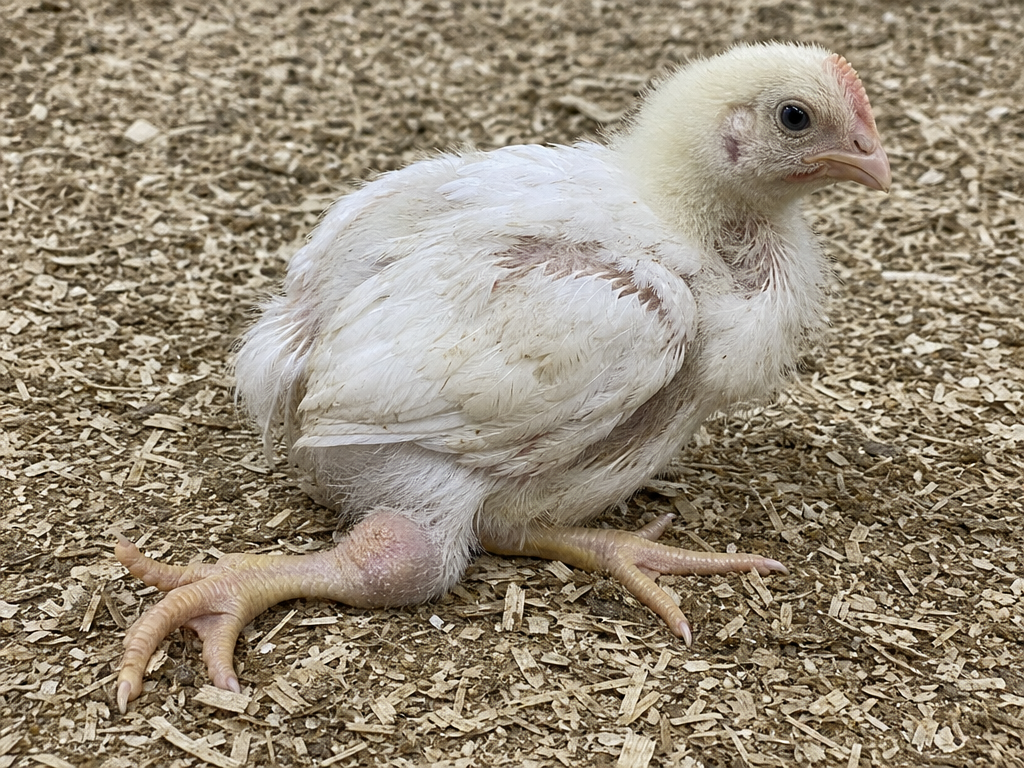
- one or both hocks visibly displaced sideways (the tendon has slipped from its groove), inability to walk normally; bird walks on hocks rather than feet, twisting or bowing of the leg at the hock joint
- Prognosis
- Good for early cases corrected with manual reduction and splinting within 7-10 days of onset. Poor for established cases with rigid hock deformity; permanent lameness results. Good for flock prevention with nutritional correction.
📑 On This Pagetap to expand
🔍What Are the Symptoms of Perosis (Slipped Tendon)?
- ●One or both hocks visibly displaced sideways (the tendon has slipped from its groove)
- ●Inability to walk normally; bird walks on hocks rather than feet
- ●Twisting or bowing of the leg at the hock joint
- ●Flat, spread, shortened metatarsal bones
- ●Enlarged, flattened hock joint
- ●Growth retardation and poor body weight
- ●Chicks at 1-3 weeks old most commonly affected
- ●Both legs may be affected simultaneously
🧬What Causes Perosis (Slipped Tendon) in Chickens?
Perosis results from deficiency of nutrients required for proper glycosaminoglycan synthesis in articular cartilage, particularly the cartilaginous groove that maintains tendon position at the hock joint.
- Manganese deficiency: The primary cause. Manganese is an essential cofactor for glycosyltransferases involved in proteoglycan synthesis. Without adequate manganese, the articular cartilage at the hock fails to form properly, the tendon groove becomes shallow, and the tendon slips. Target dietary manganese is 80-120 mg/kg in starter feeds.
- Choline deficiency: Choline is required for phospholipid synthesis in cartilage. Deficiency produces leg deformities overlapping with manganese deficiency perosis. Target choline is 1,300-1,500 mg/kg in starter feed.
- Biotin deficiency: Biotin is a cofactor in several carboxylase enzymes affecting fatty acid and amino acid metabolism in cartilage. Biotin-deficient diets produce perosis-like leg deformities.
- Zinc and niacin deficiencies: Both nutrients support normal cartilage matrix formation. Combined deficiencies amplify the risk.
- Feed ingredient interference: Phytate in grain-based diets binds manganese and zinc, reducing bioavailability. Diets high in phytate without adequate supplementation or phytase enzyme addition are a common cause of field perosis in chicks on home-mixed feeds.
🔬How Is Perosis (Slipped Tendon) Diagnosed?
Slipped tendon is visually obvious: the gastrocnemius tendon lies to the side of the hock joint rather than running through its normal central groove.
- Clinical identification: The hock is visibly displaced, with the tendon running laterally instead of centrally. The bird walks on its hocks. Both legs may be affected.
- Feed analysis: Test the feed for manganese, choline, biotin, and zinc levels. Compare against target values for the bird's age.
- Differentials: Tibial dyschondroplasia (growth plate lesion, no tendon slip), Marek's disease (progressive in older birds, neurological components), mycoplasma arthritis (joint exudate, no tendon displacement).
💊How Is Perosis (Slipped Tendon) Treated?
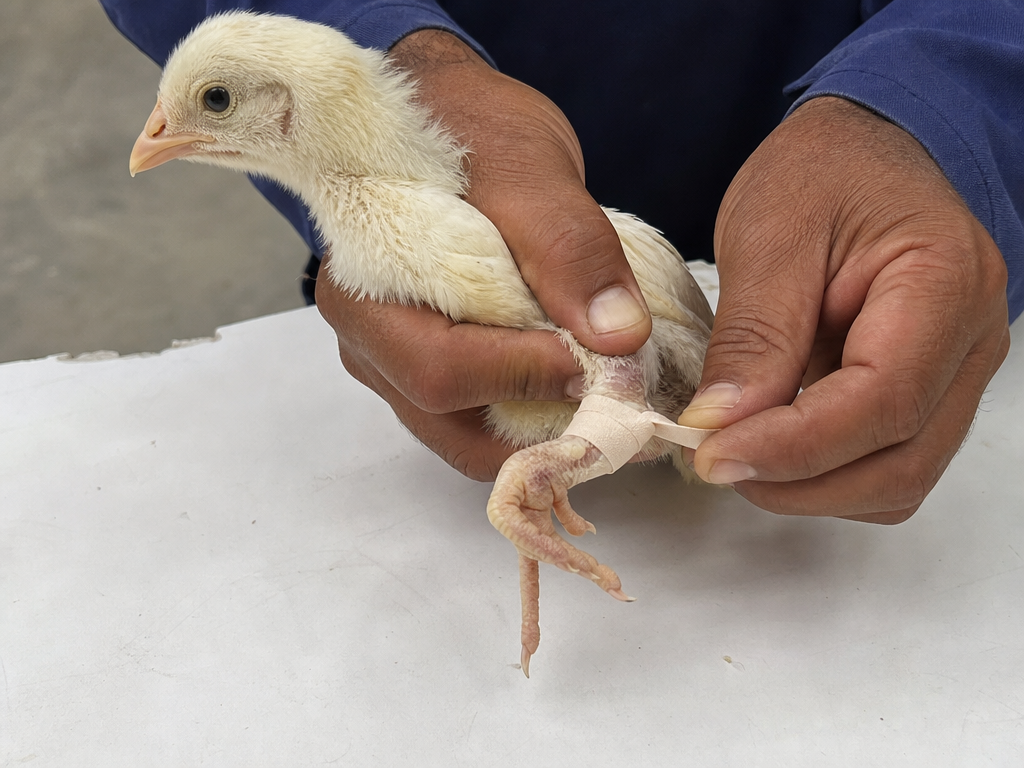
Early perosis cases in chicks 1-2 weeks old can sometimes be corrected by manually replacing the tendon and splinting the leg in proper alignment for 5-7 days.
Manual reduction (early cases only): Gently extend the leg, flex and rotate the hock to reseat the tendon in its groove. Apply a figure-8 bandage around the hock to maintain position. Change every 2-3 days. Success rate is highest in birds under 2 weeks old with flexible tissue.
Nutritional correction of the flock: Add manganese sulfate to drinking water at 2g per gallon for 1-2 weeks while the feed is reformulated. Provide a complete commercial starter feed replacing any home-mixed ration.
Advanced cases: Birds with long-standing perosis and rigid hock deformity cannot be corrected and should be humanely euthanized.
Natural & Integrative Care for Perosis (Slipped Tendon)
Perosis is prevented by feeding a complete starter with adequate manganese (80-120 mg/kg); early cases may be splinted but advanced cases leave permanent deformity.
The primary natural intervention is nutritional: ensuring adequate manganese, choline, and co-factors through feed selection.
Commercial complete starter feed: Switching to a complete commercial starter eliminates the nutritional deficiencies that cause perosis in home-mixed or scratch-heavy diets. This is the most reliable natural prevention and early management tool.
Manganese-rich foods (limited role): Cooked oatmeal, seeds, and legumes contain manganese but not in reliably bioavailable quantities sufficient to correct a clinical deficiency. Use a proper supplement, not food additions, for active deficiency correction.
🛡️How Can Perosis (Slipped Tendon) Be Prevented?
- Feed a complete commercial starter or grower diet to all chicks from hatch. Home-mixed grain diets and heavy scratch feeding are the most common causes of manganese and choline deficiency perosis.
- Verify that the starter contains at least 80-100 mg/kg manganese and 1,300 mg/kg choline. Ask your feed supplier for a nutrient analysis if in doubt.
- Add phytase enzyme to home-mixed grain-based diets. Phytase breaks down phytate, releasing bound manganese and zinc for absorption.
- Inspect chicks' legs daily from day 3 to week 3. Early identification of hock misalignment (before tendon slippage is complete) allows splinting with good success rates.
📞When Should I Call a Vet for Perosis (Slipped Tendon)?
Consult a veterinarian if:
- Multiple chicks develop slipped tendon in the first 3 weeks of life. This indicates a flock-level nutritional deficiency requiring feed reformulation.
- You are unsure whether manual reduction is appropriate for a specific bird. Improper technique can worsen the injury.
❓Perosis (Slipped Tendon): Frequently Asked Questions
What is perosis (slipped tendon) in chickens?
Perosis, called slipped tendon, occurs when the gastrocnemius tendon slips laterally from its groove at the hock joint due to abnormal cartilage development from manganese deficiency. Affected chicks cannot walk and sit on their hocks. Early cases can be manually corrected; established cases cause permanent lameness.
What causes slipped tendon in chickens?
Manganese deficiency is the primary cause. Manganese is required for proper articular cartilage formation at the hock, which maintains the tendon in its groove. Choline, biotin, and zinc deficiencies also contribute. Phytate in grain-heavy home-mixed diets binds manganese, making it unavailable even when present in the diet.
Can slipped tendon in chickens be fixed?
Early cases (birds 1-2 weeks old) can sometimes be corrected by manually reseating the tendon in its groove and splinting the leg in a figure-8 bandage for 5-7 days. Success rates are highest when treated within the first week of displacement. Advanced or long-standing cases result in permanent hock deformity that cannot be corrected.
How do you prevent perosis in baby chicks?
Feed a complete commercial chick starter from hatch. Home-mixed grain diets and scratch-heavy feeding are the primary cause of perosis because they provide insufficient manganese (target 80-120 mg/kg) and choline (target 1,300 mg/kg). Inspect leg alignment daily in chicks 1-3 weeks old to catch early cases.
Is perosis the same as Marek's disease leg problems?
No. Perosis causes visible hock displacement (tendon slips off the joint) in young chicks 1-3 weeks old and is a nutritional problem. Marek's disease causes progressive leg paralysis in older birds (usually 4-12 weeks) from nerve tumor compression, with no tendon displacement or hock deformity.
📋Key Points
- ✓Perosis results from deficiency of nutrients required for proper glycosaminoglycan synthesis in articular cartilage, particularly the cartilaginous groove that maintains tendon position at the hock joint.
- ✓Key symptoms: one or both hocks visibly displaced sideways (the tendon has slipped from its groove), inability to walk normally; bird walks on hocks rather than feet, twisting or bowing of the leg at the hock joint, flat, spread, shortened metatarsal bones.
- ✓Good for early cases corrected with manual reduction and splinting within 7-10 days of onset. Poor for established cases with rigid hock deformity; permanent lameness results. Good for flock prevention with nutritional correction.
🔗Related
Related Conditions
📚Sources & References
- 1.Perosis in Poultry. Merck Veterinary Manual. 2024
- 2.Manganese Deficiency and Skeletal Abnormalities in Poultry. PubMed / Poultry Science. 1982
- 3.Nutritional Deficiencies in Backyard Poultry. University of Georgia Extension. 2021