Northern Fowl Mites in Chickens: Symptoms, Causes and Treatment
Northern fowl mites in chickens are blood-feeding Ornithonyssus sylviarum parasites that live continuously on the bird, especially around the vent. They cause irritation, dark feather debris, anemia, pale combs, reduced laying, and weakness. Control requires treating every bird with an approved poultry product and repeating treatment after newly hatched mites emerge.
Veterinarian Reviewed
FlockVet Veterinary Editorial Team· Reviewed August 2026
At a Glance
- Urgency
- Moderate
- Contagious
- Yes
- Affects Humans
- Yes, zoonotic
- Key Symptoms
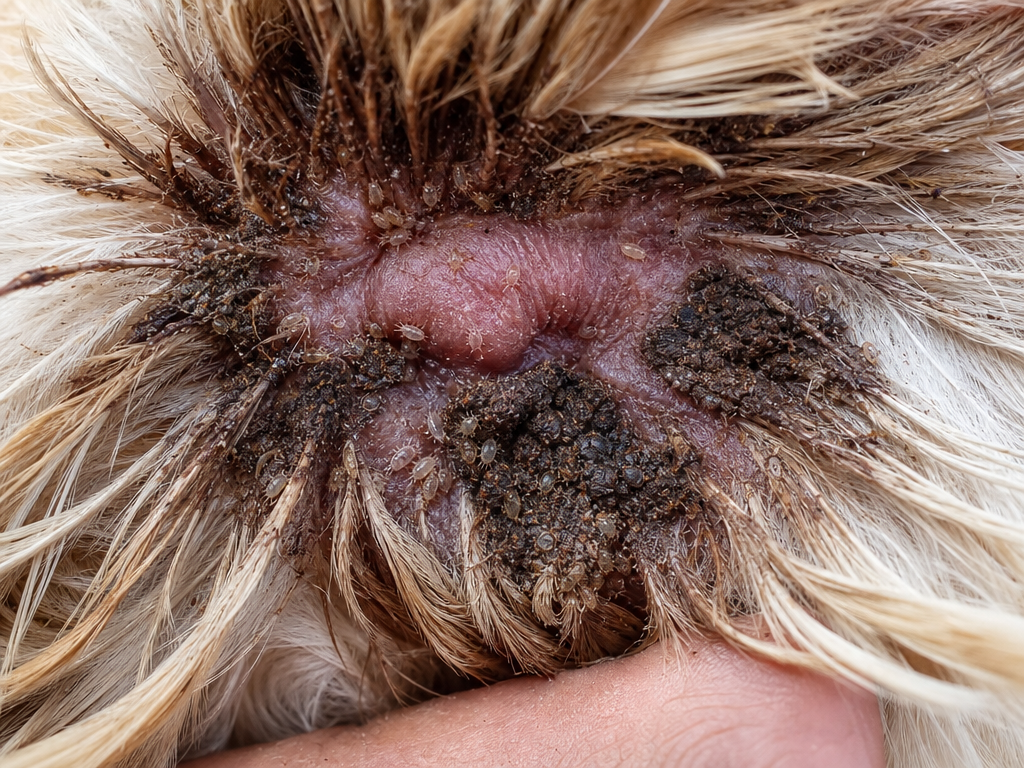
- dark brown-to-black crusty masses matted around vent and base of tail feathers, visible tiny dark mites crawling on feathers during daytime inspection, feather shafts coated with dark egg cases cemented directly to the barbs
- Prognosis
- Excellent with correct, timely treatment. A single permethrin dusting treatment repeated in 7–10 days resolves most infestations completely. Egg production and body weight return to normal within 2–3 weeks of clearing the mite burden. Prognosis worsens significantly when infestation is severe and prolonged - birds with sustained heavy mite loads can develop clinically significant anemia, secondary skin infections, and production deficits that take 4–6 weeks to fully recover. Birds treated while infestation is still mild (visible mites but no skin damage) recover with no lasting effects.
📑 On This Pagetap to expand
🔍What Are the Symptoms of Northern Fowl Mites?
- ●Dark brown-to-black crusty masses matted around vent and base of tail feathers
- ●Visible tiny dark mites crawling on feathers during daytime inspection
- ●Feather shafts coated with dark egg cases cemented directly to the barbs
- ●Restlessness, repeated preening, and self-pecking around the vent
- ●Pale comb and wattles from blood loss in heavy infestations
- ●Weight loss and reduced feed intake in severely affected birds
- ●Decreased egg production in laying hens
- ●Skin redness, scabbing, or raw patches under feathers around the vent and breast
- ●Secondary bacterial infection at skin excoriation sites
- ●Small red welts on the hands and forearms of keepers after handling birds (zoonotic bite reaction)
🧬What Causes Northern Fowl Mites in Chickens?
Northern fowl mites (Ornithonyssus sylviarum) live their entire life cycle on the bird - unlike red mites which hide in the coop.
- Direct contact with infested birds: The primary route. Mites transfer immediately when birds are housed together, during transport, or at shows. New birds are the #1 introduction vector.
- Wild bird contact: Sparrows, starlings, and other wild birds carry northern fowl mites. Open coops, gap-riddled hardware cloth, and wild bird feeders near the coop all increase exposure.
- Infested equipment and clothing: Mites survive off the host for a short period (24-72 hours). Shared equipment, nesting material from other flocks, and handling infested birds without changing clothes can transfer mites.
- Seasonal peaks: Northern fowl mites thrive in cooler weather - fall and winter see the highest infestation pressure. Populations that were suppressed by summer heat rebound aggressively as temperatures drop.
🔬How Is Northern Fowl Mites Diagnosed?
The single most reliable diagnostic step is a daytime feather examination. Lift the tail feathers and part the vent and breast feathers. Northern fowl mites are visible to the naked eye as tiny (0.8–1.0 mm) dark-brown to black fast-moving specks. The presence of dark egg masses cemented to feather shafts is pathognomonic - no other common poultry parasite produces this sign.
Step-by-step field diagnosis:
- Examine the bird in daylight (not artificial light after dark - that is when red mites are active).
- Part feathers at the vent, base of tail, and lower breast. Look for dark gritty debris stuck to feather shafts.
- Place a white paper towel under the bird and ruffle feathers briskly. Northern fowl mites fall and are visible as moving dark specks - red mites do not fall from birds during daytime because they are not on the bird.
- Check your own hands and arms after handling: small red welts within 20–30 minutes indicate live mites transferred from the bird.
Northern Fowl Mite vs. Red Mite - Critical Comparison:
| Feature | Northern Fowl Mite (O. sylviarum) | Red Mite (D. gallinae) |
|---|---|---|
| Where they live | On the bird 24/7 | In coop cracks; on bird only at night |
| Visible during daytime inspection | Yes - on feathers | No - hiding in coop |
| Color | Dark brown to black at all stages | Gray before feeding; bright red after |
| Egg masses | Cemented to feather shafts (dark, gritty) | Laid in coop cracks and debris |
| Where to treat | The bird (dust/spray directly) | The coop (clean, spray surfaces) |
| Off-host survival | 2–3 weeks | 8–12 hours typically |
| Zoonotic risk | Yes - bites humans handling birds | Yes - bites humans in the coop at night |
Differential diagnoses to rule out:
- Lice (chewing lice, Menacanthus spp.): Also on-bird; produce white or tan egg clusters (nits) glued to feather shafts near the skin, not dark masses. Lice move more slowly and are larger (1.5–2.5 mm).
- Red mites (Dermanyssus gallinae): Not on bird during daytime. Coop inspection after dark reveals mites in cracks and under roost boards. Treat the coop environment, not the bird.
- Scaly leg mites (Knemidocoptes mutans): Burrow under leg scales - affect legs, not feathers. Different protocol entirely (smothering oil applied to legs).
- Vent pecking / feather loss: No visible mites or eggs on feather shafts; dark debris absent; skin trauma without accompanying parasite population.
💊How Is Northern Fowl Mites Treated?
All treatments target the bird directly. There is no coop treatment required for northern fowl mites (unlike red mites). Treat every bird in the flock simultaneously - partial treatment allows reinfestation from untreated carriers.
First-line: Permethrin 0.25% dust
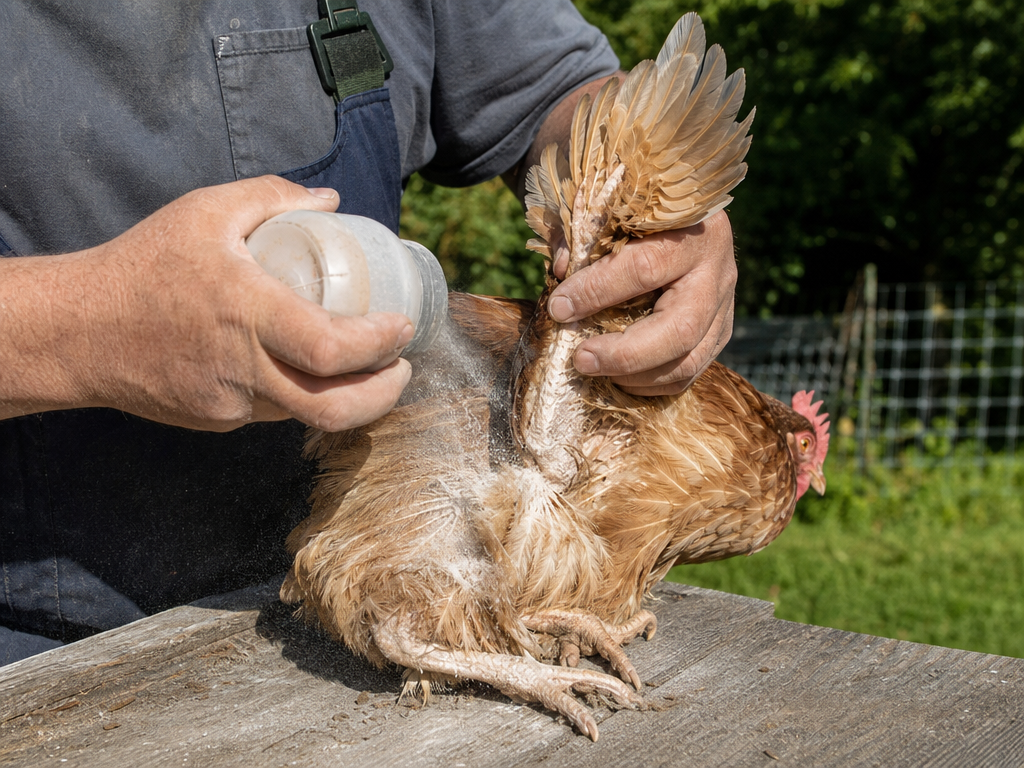
- Apply directly to the bird's feathers, working the dust under the feathers to skin level.
- Focus on vent, base of tail feathers, under wings, and breast - where egg masses concentrate.
- Use approximately 1–2 tablespoons per bird, massaged thoroughly into the feather coat.
- Repeat in 7–10 days to kill mites that have hatched from surviving eggs after the first treatment.
- Do not apply to eyes, nostrils, or mouth. Keep dust away from your own face during application.
- Egg withdrawal: 17 days after last treatment for laying hens. Meat withdrawal: consult your state extension service.
Alternative: Spinosad spray (Elector PSP or equivalent)
- Mix per label directions (typically 9 mL per quart of water for direct bird application).
- Spray directly onto feathers, parting them to reach skin. Pay particular attention to vent and breast areas.
- Spinosad kills by contact and ingestion during preening. Effective against pyrethroid-resistant mite populations.
- Single treatment is often sufficient, but recheck in 14 days and re-treat if live mites persist.
- Approved for use in organic poultry production under the National Organic Program.
Alternative: Pyrethrin spray or dust
- Derived from chrysanthemum flowers; shorter residual activity than permethrin (synthetic pyrethroid).
- Apply directly to feathers as above. More frequent repeat treatments (every 5–7 days for 3 cycles) needed compared to permethrin.
- Preferred by some keepers for its natural origin and faster environmental breakdown.
Environmental control (secondary, but important):
- Even though mites live on the bird, the 2–3 week off-host survival means transport crates, handling equipment, and contaminated clothing should be cleaned. Wash with hot water and detergent or spray with dilute permethrin solution.
- Block wild bird access to feeders, waterers, and coop openings - the primary route of reinfestation.
- Quarantine new birds for 30 days and inspect thoroughly before adding to the flock.
Natural & Integrative Care for Northern Fowl Mites
Permethrin dust applied directly to the bird clears established northern fowl mite infestations reliably; natural approaches like diatomaceous earth and neem oil are most useful for maintenance and mild prevention between treatment cycles.
Natural approaches are most effective for mild infestations (few mites, no skin damage) and as prevention between conventional treatment cycles. They are supportive care, not a replacement for permethrin or spinosad in an established infestation. Be honest about scope before starting: if you can see dark egg masses covering the vent area, start with conventional treatment first.
Diatomaceous earth (food-grade DE) - mechanical, not chemical
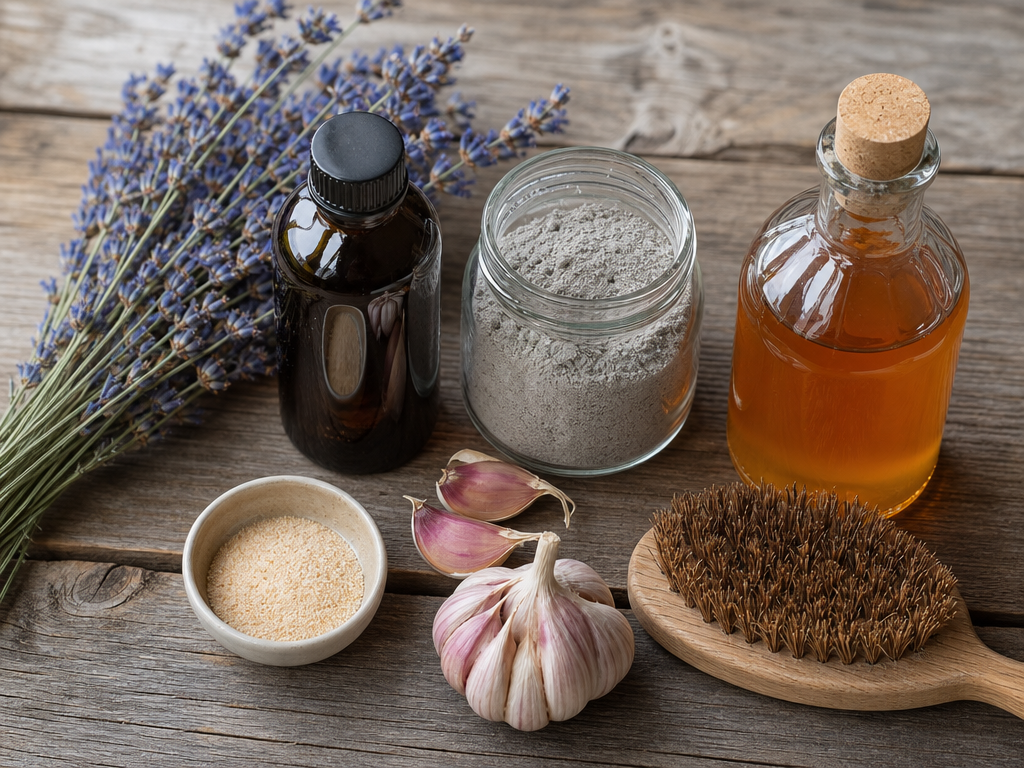
- Apply food-grade DE by hand to feathers, focusing on vent, breast, and under wings. Work it down to skin level.
- Add DE to dust bath areas. Chickens self-apply during natural dust bathing behavior.
- DE works by desiccating the mite's waxy exoskeleton - it is effective only when dry. Wet conditions render it inert.
- Repeat every 3–5 days for 3 weeks. Slower acting than permethrin; requires consistency to work.
- Food-grade only - never pool filter grade, which has different particle characteristics and lung risk.
Neem oil spray
- Mix 2 tablespoons neem oil + 1 teaspoon liquid castile soap + 1 quart warm water. Emulsify well.
- Spray directly onto feathers, parting to reach skin. Avoid face, eyes, and nostrils.
- Azadirachtin (neem's active compound) disrupts the mite's molting hormones and reduces reproduction. It is not a fast knockdown agent.
- Apply every 5–7 days for 4–6 weeks. Most effective for reducing population growth in mild cases.
Garlic juice spray
- Blend 4–6 garlic cloves with 1 quart water; strain and spray on feathers.
- Allicin and other sulfur compounds in garlic have documented repellent activity against ectoparasites in poultry research.
- Apply weekly as a maintenance strategy or preventive between infestations.
Dust bath enrichment - ongoing management
- Ensure all birds have daily access to dry dust bath areas. Dust bathing is the bird's primary self-grooming mechanism against ectoparasites.
- Enhance dust bath effectiveness by adding a mixture of: dry fine sand (50%), wood ash (25%), and food-grade DE (25%).
- Maintain dryness - a wet or muddy dust bath is useless and may worsen skin conditions.
Oregano oil supplementation (internal immune support)
- Add 3–5 drops of food-grade oregano oil per gallon of drinking water during active infestation.
- Supports skin barrier integrity and overall immune response - indirect support, not a direct miticide.
🛡️How Can Northern Fowl Mites Be Prevented?
- Block wild bird access - cover feeders, use treadle feeders that close when unoccupied, and seal any openings where sparrows or starlings can nest in or around the coop
- 30-day quarantine for new birds - inspect every new bird thoroughly for dark vent debris and mites before introducing to the existing flock
- Monthly feather inspections - part vent and breast feathers on 3–5 birds monthly; catching an early infestation (10–20 mites) is dramatically easier to clear than a full-blown population
- Maintain active dust bath areas - dry, deep dust baths enriched with wood ash and food-grade DE support the flock's natural self-grooming defense continuously
- Disinfect transport equipment - wash crates, show equipment, and handling tools between uses, especially after contact with birds from other flocks at shows or auctions
- Treat new birds prophylactically - apply permethrin dust or pyrethrin spray to all incoming birds at the start of quarantine, before they have contact with the resident flock
- Avoid shared equipment at poultry shows - northern fowl mites survive 2–3 weeks off a host; shared crates and handling equipment are a known transmission route at exhibitions
- Seasonal vigilance in fall and winter - wild bird pressure on feeders peaks in cold months; increase inspection frequency when wild bird activity near the coop is highest
📞When Should I Call a Vet for Northern Fowl Mites?
Call a veterinarian if:
- The bird's comb and wattles are pale or white - this indicates blood-loss anemia from heavy infestation and requires assessment of severity before home treatment is safe
- Skin at the vent or breast is raw, weeping, or showing signs of secondary bacterial infection (odor, pus, swelling, spreading redness)
- The bird is lethargic, hunched, or unable to stand - severe infestation has progressed to systemic disease
- Two full permethrin treatment cycles (initial + 7–10 day repeat) have not cleared the infestation - this may indicate pyrethroid-resistant mite populations requiring spinosad or a different approach
- Multiple birds in the flock are simultaneously severely affected - a flock-wide heavy infestation warrants professional assessment of treatment protocol and timing
- You or other household members develop persistent skin reactions after handling birds - a vet can confirm the parasite species and advise on human exposure management
❓Northern Fowl Mites: Frequently Asked Questions
Can northern fowl mites live on humans?
Northern fowl mites cannot complete their life cycle on humans. They may bite a person handling infested birds, causing a temporary itchy rash, but they cannot survive on human skin for more than a few days without a bird host. A shower and change of clothes after handling infested birds is sufficient.
Do northern fowl mites bite humans?
Yes, northern fowl mites can bite humans when they come in contact with infested birds or nesting areas. Bites cause a red, itchy rash on the arms, neck, and chest - anywhere that touched the birds. The mites do not infest humans and the bites resolve within a few days.
How do you get rid of northern fowl mites?
Treat all birds in the flock with permethrin-based poultry dust or spray, focusing on the vent, under the wings, and around the neck. Because northern fowl mites live on the bird rather than in the coop, treating the birds is the priority. Repeat treatment in 7-10 days to catch emerging nymphs.
How do you identify northern fowl mites?
Northern fowl mites are tiny (about 1mm), dark gray to almost black insects found on the bird at all times. Check the vent area and base of tail feathers - severe infestations cause the feathers around the vent to turn dark brown or black from mite feces and dried blood. Eggs appear as white clusters at feather bases.
What is the difference between northern fowl mites and red mites?
Northern fowl mites (Ornithonyssus sylviarum) stay on the bird at all times and are found primarily around the vent and tail. Red mites (Dermanyssus gallinae) hide in coop crevices during the day and only come on birds at night to feed. Northern fowl mites are easier to find on the bird but red mites require nighttime inspection.
📋Key Points
- ✓Northern fowl mites (Ornithonyssus sylviarum) live their entire life cycle on the bird - unlike red mites which hide in the coop.
- ✓Key symptoms: dark brown-to-black crusty masses matted around vent and base of tail feathers, visible tiny dark mites crawling on feathers during daytime inspection, feather shafts coated with dark egg cases cemented directly to the barbs, restlessness, repeated preening, and self-pecking around the vent.
- ✓Excellent with correct, timely treatment. A single permethrin dusting treatment repeated in 7–10 days resolves most infestations completely. Egg production and body weight return to normal within 2–3 weeks of clearing the mite burden. Prognosis worsens significantly when infestation is severe and prolonged - birds with sustained heavy mite loads can develop clinically significant anemia, secondary skin infections, and production deficits that take 4–6 weeks to fully recover. Birds treated while infestation is still mild (visible mites but no skin damage) recover with no lasting effects.
- ✓This condition is contagious, isolate affected birds promptly.
- ✓This condition is zoonotic and can potentially affect humans. Practice thorough hygiene when handling sick birds.
🔗Related
Related Conditions
Medications
Natural Remedies & Supplements
📚Sources & References
- 1.Northern Fowl Mite in Poultry. Merck Veterinary Manual. 2024
- 2.External Parasites of Poultry. Merck Veterinary Manual. 2024
- 3.Lice and Mites of Poultry. University of Georgia Cooperative Extension Poultry Science. 2022