Sudden Death Syndrome in Chickens: Causes, Prevention and Breed Risk
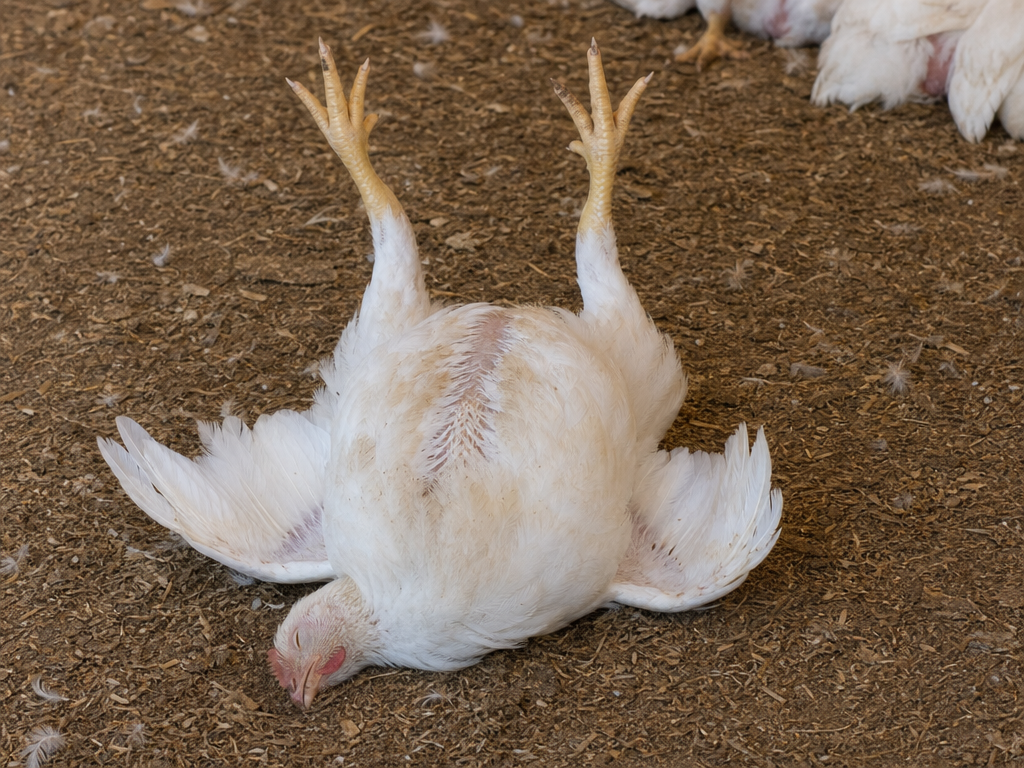
Sudden Death Syndrome (SDS), also called flip-over disease, is a metabolic cardiac condition in which otherwise healthy, fast-growing broiler chickens die suddenly. Birds are found on their backs with legs extended, having died during a cardiac arrhythmia. It most commonly affects males at 2-4 weeks of age. There is no treatment. Dietary and management strategies can reduce incidence.
Veterinarian Reviewed
FlockVet Veterinary Editorial Team· Reviewed August 2026
This is a veterinary emergency.
If your bird is showing these signs, contact a veterinarian immediately. Do not wait. Time-sensitive conditions can deteriorate rapidly without professional intervention.
At a Glance
- Urgency
- Emergency
- Contagious
- No
- Affects Humans
- No
- Key Symptoms
- chicken found dead on its back with feet extended upward (the 'flip-over' posture), death occurs in birds that appeared completely healthy hours or minutes earlier, short wing-flapping or convulsive movement immediately before death (occasionally witnessed)
- Prognosis
- No individual bird prognosis - death is instantaneous. For the flock, implementing feed restriction in the first 2 weeks consistently reduces SDS mortality from typical rates of 0.5-2% to 0.1-0.5%. A low, steady background rate of SDS (under 0.5% of the flock) is considered normal and unavoidable in fast-growing broiler breeds.
📑 On This Pagetap to expand
🔍What Are the Symptoms of Sudden Death Syndrome (Flip-Over Disease)?
- ●Chicken found dead on its back with feet extended upward (the 'flip-over' posture)
- ●Death occurs in birds that appeared completely healthy hours or minutes earlier
- ●Short wing-flapping or convulsive movement immediately before death (occasionally witnessed)
- ●Affects well-grown, heavy birds more than small or poorly-conditioned birds
- ●Males affected 3-4 times more often than females
- ●Peak mortality at 2-4 weeks of age in fast-growing broiler breeds
- ●No prior clinical signs of illness in affected birds
🧬What Causes Sudden Death Syndrome (Flip-Over Disease) in Chickens?
Sudden Death Syndrome results from a fatal cardiac arrhythmia caused by metabolic imbalances associated with extremely rapid growth and increased cardiac demand.
- Rapid growth rate: Modern broiler genetics have been selected for growth rates far beyond what the cardiovascular system was designed to support. The heart cannot always keep pace with oxygen demands of rapidly expanding muscle mass, creating conditions for arrhythmia.
- High-energy diets: High-calorie, high-protein starter diets that maximize early growth also maximize cardiac strain. Birds consuming ad libitum high-energy feed have higher SDS rates than those on restricted or lower-density diets.
- Electrolyte imbalances: Potassium and sodium imbalances in rapidly growing birds alter cardiac conduction. Feed acidifiers, bicarbonate supplementation, and dietary cation-anion balance affect SDS rates.
- Genetic predisposition: Certain fast-growing broiler lines have inherently higher SDS rates. Heritage and dual-purpose breeds very rarely experience SDS.
- Stress events: Noise, handling, catching, and sudden disturbances can trigger cardiac events in predisposed birds, appearing as SDS in the hours following the stress.
🔬How Is Sudden Death Syndrome (Flip-Over Disease) Diagnosed?
The characteristic finding of a bird on its back with legs extended, in otherwise good condition, is the primary diagnostic criterion for SDS.
- Post-mortem examination: Affected birds are often the largest, healthiest-appearing birds in the flock. Findings include congested lungs, fluid in the pericardial sac (hydropericardium), and a dilated, pale heart. Histopathology reveals myocardial degeneration.
- Flock pattern: SDS typically affects 0.5-2% of a fast-growing broiler flock. If mortality is higher, consider other causes (ascites, infectious disease). SDS does not spread and does not cluster in specific areas of a house.
- Differentials: Ascites (water belly) - bird is on its side or abdomen, not back; legs not extended; palpable fluid. Infectious causes - other birds show signs. Egg binding in layers (obviously not relevant in broilers).
💊How Is Sudden Death Syndrome (Flip-Over Disease) Treated?
There is no treatment for SDS - death is instantaneous from cardiac arrest. Management strategies aim to reduce flock-level incidence.
Feed restriction (skip-a-day or 6-hours-off programs): Restricting feed access by 6-8 hours per day during weeks 1-2 significantly reduces SDS incidence without compromising final body weight at market. This is the most evidence-supported intervention.
Lower dietary energy density: Reducing dietary metabolizable energy by 100-150 kcal/kg during the starter phase (0-14 days) reduces SDS without proportional impact on final weight.
Sodium bicarbonate supplementation: Adding sodium bicarbonate at 0.3-0.5% of feed can reduce SDS in some studies by buffering blood pH. Results are inconsistent across trials.
Potassium supplementation: Ensuring adequate potassium (>0.8% of diet) supports proper cardiac conduction. Potassium deficiency has been associated with higher SDS rates in some studies.
Natural & Integrative Care for Sudden Death Syndrome (Flip-Over Disease)
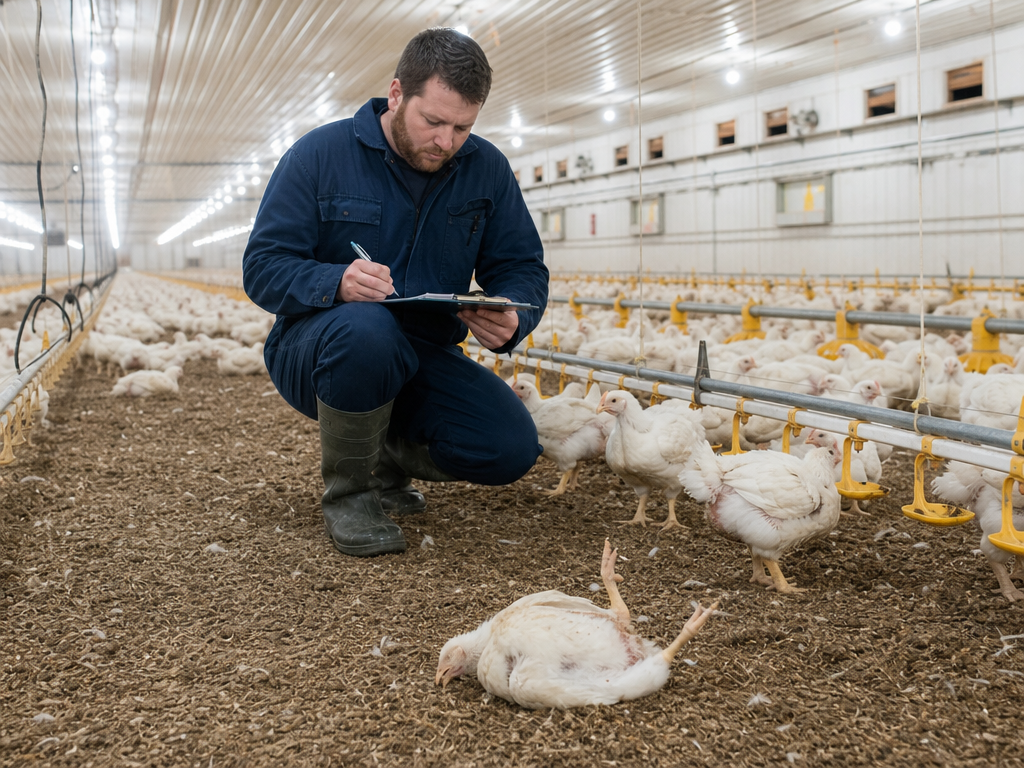
Feed restriction during the first 2 weeks of life is the primary evidence-based strategy to reduce SDS incidence in fast-growing broiler breeds.
Natural management approaches mirror conventional interventions, as both focus on reducing growth rate and metabolic stress.
Reduce feed density with lower-energy ingredients: For small backyard broiler flocks, replacing a portion of the high-energy starter with oats or barley (up to 10% of diet) naturally reduces energy density and slows peak growth rate without requiring feed restriction.
Exercise stimulation: Encouraging activity (larger pens, perches, enrichment) reduces the sedentary pattern that exacerbates cardiac strain in fast-growing birds.
🛡️How Can Sudden Death Syndrome (Flip-Over Disease) Be Prevented?
- Use skip-a-day or 6-hours-off feed restriction programs during the first 2 weeks in fast-growing broiler breeds. This is the single most effective management tool for reducing SDS rates.
- Avoid high-energy, high-protein starter feeds if raising Cornish Cross or similar fast-growing breeds in a backyard setting. Grower or finisher rations with lower energy density from the start reduce early cardiac strain.
- Minimize stress events in the 2-4 week age window when SDS is most common. Avoid catching, moving, or vaccinating birds during the peak risk period if possible.
- Consider heritage breed alternatives. Dual-purpose and heritage breeds grow at half the rate of commercial broilers and have nearly zero SDS incidence. They require longer grow-out time but are far more robust metabolically.
📞When Should I Call a Vet for Sudden Death Syndrome (Flip-Over Disease)?
Consult a veterinarian if:
- More than 1-2% of your flock is dying suddenly in the back-up-legs-extended posture. Rates above 2% suggest a contributing nutritional deficiency, electrolyte imbalance, or concurrent condition beyond typical SDS.
- You are unsure whether sudden deaths are from SDS, ascites, or an infectious condition. A necropsy on 2-3 fresh carcasses will differentiate these conditions quickly.
❓Sudden Death Syndrome (Flip-Over Disease): Frequently Asked Questions
What is sudden death syndrome (flip-over disease) in chickens?
Sudden death syndrome is a cardiac condition in which fast-growing broiler chickens die instantly from cardiac arrhythmia with no prior signs. Birds are found on their backs with feet extended upward. It most commonly affects healthy, well-grown males at 2-4 weeks. There is no treatment; dietary management reduces incidence.
Why does my chicken keep dying suddenly with no signs of illness?
If fast-growing broiler birds (Cornish Cross, Ross 308) are dying suddenly and found on their backs with legs extended, this is most likely Sudden Death Syndrome. It affects 0.5-2% of fast-growing broiler flocks. Birds with SDS are typically the largest, healthiest-appearing birds, which distinguishes it from infectious causes that affect weaker birds first.
How do you prevent sudden death syndrome in chickens?
Feed restriction during the first 2 weeks of life is the most evidence-based prevention. Restricting feed access by 6-8 hours daily reduces SDS incidence without significantly affecting final body weight. Lower-energy starter diets and ensuring adequate dietary potassium also help. Heritage and dual-purpose breeds almost never experience SDS.
Does sudden death syndrome spread between chickens?
No. SDS is a metabolic cardiac condition, not an infectious disease. It does not spread between birds and does not cluster in specific flock areas. Each affected bird experiences an independent cardiac event. The uniform flock-level management strategy (feed restriction) reduces the overall risk for all birds simultaneously.
What breeds are most at risk for sudden death syndrome?
Fast-growing commercial broiler breeds (Cornish Cross, Ross 308, Cobb 500) are almost exclusively affected. These breeds have been selected for growth rates that strain cardiovascular capacity. Heritage breeds, dual-purpose breeds, and laying hens essentially never experience SDS because their growth rates are far more moderate.
📋Key Points
- ✓Sudden Death Syndrome results from a fatal cardiac arrhythmia caused by metabolic imbalances associated with extremely rapid growth and increased cardiac demand.
- ✓Key symptoms: chicken found dead on its back with feet extended upward (the 'flip-over' posture), death occurs in birds that appeared completely healthy hours or minutes earlier, short wing-flapping or convulsive movement immediately before death (occasionally witnessed), affects well-grown, heavy birds more than small or poorly-conditioned birds.
- ✓No individual bird prognosis - death is instantaneous. For the flock, implementing feed restriction in the first 2 weeks consistently reduces SDS mortality from typical rates of 0.5-2% to 0.1-0.5%. A low, steady background rate of SDS (under 0.5% of the flock) is considered normal and unavoidable in fast-growing broiler breeds.
🔗Related
Related Conditions
📚Sources & References
- 1.Sudden Death Syndrome in Broilers. Merck Veterinary Manual. 2024
- 2.Sudden Death Syndrome in Broiler Chickens. PubMed / Poultry Science. 1992
- 3.Metabolic Disorders of Poultry. University of Georgia Extension. 2020